Editorial note: This guide draws on research into spatial arrangement and conversation quality from environmental psychology, a 2020 PLOS ONE study on paired walking and first impressions, first-person accounts published in AARP, Next Avenue, and Time. We are not dating coaches or therapists. If what you feel before a first date is closer to dread than nervousness, a conversation with a counsellor who understands later-life transitions may be more useful than any article.
You have agreed to meet someone. A name from an app, a suggestion from a friend, a person you spoke to briefly at something last month. Now you need to decide what the meeting actually looks like — and for many people arranging a first date after 60, that decision carries more weight than it should.
The weight comes from a specific place. A dinner across a table, two hours of sustained eye contact, an unspoken evaluation happening in both directions — that format worked well enough when you were thirty and meeting strangers was ordinary. After decades away from dating, it can feel less like a date and more like an audition. You are performing a version of yourself while simultaneously trying to assess whether this person deserves your Tuesday evening.
The best first date after 60 has a built-in reason to end.
That sounds like pessimism, but it is structural design. When a date has a natural stopping point — a park loop that finishes, a coffee that cools, an exhibition that closes — neither person needs to manufacture an exit or endure a slow decline in conversation. The format does the work. What follows is not a list of “fun date ideas.” It is an explanation of what makes certain formats reduce pressure and how to choose one that fits your energy, your body, and your actual life. If you are still in the earlier stage of deciding whether dating over 60 is something you want at all, that guide covers the broader landscape.
The deeper hesitation is rarely about logistics. It is about exposure. Going on a first date means admitting you want something — companionship, touch, someone to talk to on a Thursday — and if the date goes badly, you have shown that wanting to a stranger who now knows you are trying. That vulnerability is not irrational. It is the cost of acting on a desire you could have kept private.
There is a particular kind of courage in this that nobody talks about. Not the courage of “putting yourself out there” — that phrase is patronising and you have probably heard it enough times to wince at it. The courage of being sixty-four and driving to a botanical garden on a Wednesday morning knowing that you might sit in the car park for five minutes beforehand, steadying yourself, because the last person you went anywhere with was your husband, and he has been gone for three years, and this feels like a small betrayal even though you know it is not. That is not logistics. That is grief and desire occupying the same body at the same time, and no date-format advice resolves it. But choosing a format that feels low-stakes does not make the desire smaller. It makes the risk of exposure manageable enough to take.
What Makes a Date Feel Like an Audition
A dating client quoted in Time magazine put it plainly after a string of tense first meetings: “We all need to stop taking first dates so seriously.” The men she met had “conducted the conversation like a meeting.” That is the audition dynamic — when both people are simultaneously performing and evaluating, the date becomes a mutual interview rather than a conversation.
Three structural features produce this feeling, and they are all present in the default dinner-date format:
Face-to-face orientation. Sitting directly opposite someone for ninety minutes creates sustained mutual gaze. That sounds romantic in theory. In practice, for two strangers who met on an app last Wednesday, it produces the same body-language dynamics as a job interview: evaluative eye contact, performative posture, nowhere to look when the conversation pauses.
Open-ended duration. When there is no natural end point, both people are silently calculating when they can leave without seeming rude. That calculation consumes attention that could be directed at the other person. Zack Rogow, who was 66 and living in Berkeley when he started dating again after 35 years, described one date where the woman arrived 45 minutes late to a café that was already an hour from his house — then talked without pause for two hours. He could not leave. The format offered no exit. “Let’s do this again. You’re such a great conversationalist!” she said afterward. He had barely spoken.
No third point of focus. What do you talk about when there is nothing else to react to? That question hangs over every dinner date between strangers. When two people sit across a table with nothing between them except their own conversation, the conversation itself becomes the performance. Every silence feels like a failure. Every topic change feels abrupt. There is nothing else to look at, comment on, or use as a bridge when the talk stalls. Kathleen Rehl, a financial planner who was widowed at 60 and started dating after more than two decades out of the scene, reflected on her early dates with blunt self-assessment: “Looking back at my first dates, you might even say I was pathetic.” She described dinners and concerts — face-to-face formats where the pressure to perform conversation sat squarely on both people with nothing to absorb the silences.
These three features are design choices, not inevitabilities. And once you see them as choices, you can choose differently.
What Reduces the Pressure
If the audition dynamic comes from structure, the fix is structural too. But the solution is not “do the opposite of dinner” applied three times in a row. It is understanding one principle and letting it shape your choices.
The principle is this: people relax when they are not the sole focus of someone else’s sustained attention.
Walking next to someone rather than sitting across from them reduces sustained eye contact and frees cognitive resources for language and storytelling. The absence of direct visual scrutiny lowers emotional inhibition. People disclose more when they are not being watched continuously. A 2020 study published in PLOS ONE found that paired walkers formed better first impressions of each other in under ten minutes, whether or not they were actually talking. The physical arrangement does something before conversation even begins.
I would steer most people toward a side-by-side format for a first meeting after 60, for one reason: it removes the performance of eye contact from the equation at exactly the moment when performance anxiety is highest. You can still look at each other. You just do not have to.
That single shift cascades into two others. When you are walking somewhere together, the walk itself creates a natural end point: the loop finishes, you arrive at the café, the garden gate appears. Nobody has to decide when to leave. The format decides. This removes the entire layer of social calculation that makes open-ended dinners exhausting: Is it too early to leave? Will they think I’m not interested? Are we both pretending this is going well? A 45-minute window removes those questions while preserving the option to extend. “Want to keep walking?” after a park loop is easy and genuine. Nobody says “Want to keep sitting here?” after two hours of dinner.
And the environment around you becomes a shared third point of focus. An art exhibition you both look at. A garden path you both notice. A market stall you both stop at. The third point gives you something to react to together, and reaction reveals personality more honestly than answers to interview questions. When you watch someone notice a painting, laugh at a stall display, or stop to read a plaque, you learn something about them that no amount of “So, tell me about yourself” would produce.
Think of these three features as a filter rather than a formula. Any date format that includes at least two of the three will feel significantly less like an audition than a standard dinner.
Date Formats That Use All Three
Rather than ranking ideas or numbering them, here are formats grouped by what they structurally offer. Choose based on which features matter most to you.
The morning walk. A botanical garden, a town path with a known loop, or a stretch of waterfront with a café at the end. Duration is controlled by the route. You are side-by-side the entire time. The surroundings give you something to notice together. If you have mobility considerations, a flat paved garden with benches every hundred metres works better than a trail. Total time: 30–50 minutes.
Mina Grace Ward, 58 and living in Elk Grove, California, described returning to dating after two marriages and 35 combined years: “It was not like riding a bicycle… not even close.” For someone in that position — decades since the last first date, unfamiliar with the current mechanics — a morning walk demands nothing except showing up and moving forward. The format is forgiving in a way that dinner is not.
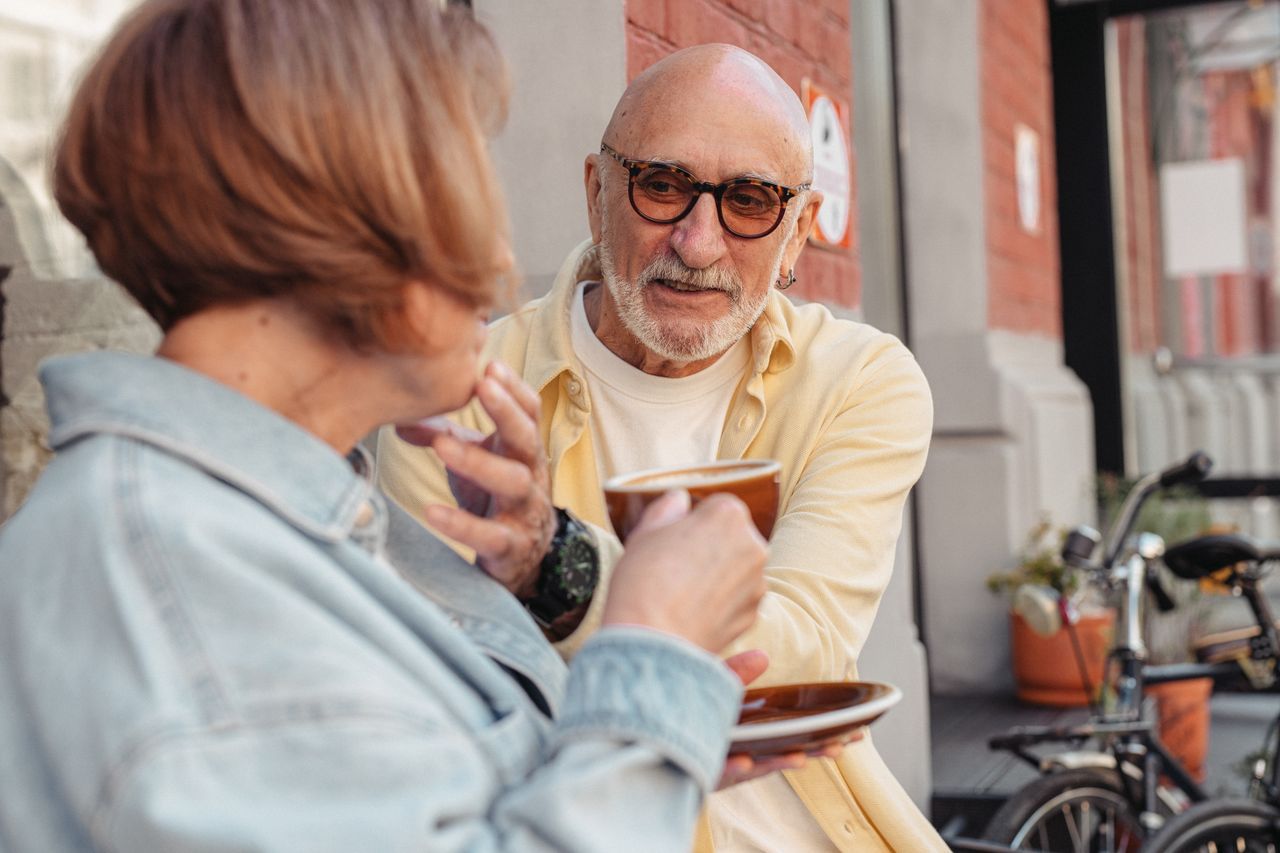
The weekday coffee with a soft boundary. A café at 10:30 on a Tuesday. You have “something at noon” — whether or not you do. That boundary gives both people permission to leave after 45 minutes without manufacturing an excuse. The setting is face-to-face, but short enough that sustained eye contact does not become oppressive. Coffee works best when the café has some visual texture: a window onto a street, a bookshelf, other people moving through. A blank-walled chain coffee shop on a quiet morning offers no third point. One reader’s account of a single Thursday coffee date at 62 after divorce captures what this format feels like in practice — the preparation, the awkward first minutes, and the mild relief afterward.
Then there is the gallery or museum. Imagine you arrive at 11am. You stand in front of the first painting, both of you slightly uncertain about the etiquette of talking in a gallery. One of you says something about the colour. The other laughs. You drift to the next room, stop at different things, reconvene without planning to. Silences happen and they are built into the experience — nobody talks continuously in a gallery. By 11:45 you have learned something about this person’s attention, their sense of humour, what they notice and what they walk past. The venue has opening hours, so the date ends itself. One limitation: some galleries are quiet enough that any conversation feels conspicuous. A busier exhibition or a museum with ambient sound works better for a first meeting than a reverent, near-silent space.
If none of those sound right, consider the opposite of the coffee shop: a farmer’s market or street fair. Where coffee is still, a market moves. You walk side-by-side. You stop at stalls. You react to things together — the absurd price of that cheese, the smell of that soap, the dog wearing a bandana. The format naturally produces shared micro-reactions, which build ease faster than an hour of deliberate conversation. The crowd provides comfortable anonymity, and leaving is as simple as “I should head off” at the end of any row. Weekend mornings work best, when energy is higher and the light is good.
The Date Format Chooser
Here is how this works in practice. A reader we will call Margaret, 64, recently widowed, matched with someone on a dating site for the first time. She has not been on a date in 38 years. She is nervous about silence more than anything else.
Margaret’s path through the chooser:
- Do you want to face each other, or be side-by-side? → Side-by-side. She does not want to be looked at for an hour.
- Do you want a fixed end time, or an open window? → Fixed. She wants to know she can leave after 40 minutes without it being awkward.
- Do you want something to do together, or just to talk? → Something to do. She is worried about running out of things to say.
Margaret’s format: A weekday morning walk through a botanical garden with a known loop. She drives herself, arrives five minutes early, texts her daughter the location. The loop takes 35 minutes. If it goes well, there is a café at the exit. If it does not, her car is in the car park and the walk is over.
Now yours:
Question 1: Do you want to face each other or be side-by-side?
- Face-to-face → coffee, lunch, bench in a park
- Side-by-side → walk, gallery, market, garden
Question 2: Do you want a fixed end time or an open window?
- Fixed → choose a format with a natural stopping point (a loop, closing hours, a “something at noon” excuse)
- Open → choose a format that can extend if things go well (coffee that becomes lunch, a walk that becomes a pub stop)
Question 3: Do you want something to do together or just to talk?
- Something to do → gallery, market, garden, exhibition
- Just to talk → coffee, bench, quiet pub in the afternoon
Where your answers intersect is your format. You do not need to be creative. You need to be comfortable.
Before You Get There
Most first-date advice focuses on what to do during the date. The parts that actually determine whether you enjoy it happen before and after.
Exit architecture. Decide before you arrive how you will leave. Drive yourself or take transport you control. Know where your car is parked. Have a sentence ready that ends the date without drama: “This was lovely — I’m going to head off” is enough. You do not need an excuse. You do not need to explain. Nobody over 60 should feel trapped in a date they want to leave. If you are meeting someone from an app for the first time, the basics in our online dating safety guide apply: public place, tell someone where you are, keep your phone charged.
Energy management. A first date consumes more energy than the activity itself would suggest. The social performance, the novelty, the sustained attention — these are cognitively expensive, especially if you have not done them in years. Schedule the date when your energy is naturally higher. For most people over 60, that means morning or early afternoon, not 7pm after a full day. If you know you fade after 2pm, do not book a 3pm coffee and wonder why you felt flat.
I am genuinely unsure whether evening dates carry a different emotional register for this age group — whether the darkness and the wine and the associations with romance create a specific kind of pressure that daytime avoids, or whether that is just an artefact of the advice columns I have read. I include that uncertainty because the honest answer is: try both and notice which one makes you feel more like yourself.
What to wear. Wear what you would wear to meet a friend at the same venue. Nothing new, nothing performance-level. If you would not normally wear a blazer to a Tuesday morning botanical garden, do not wear one now. The goal is to present the version of yourself that the person will actually encounter on date two, three, and four. Dressing up creates a gap between the first impression and the reality — and at 60, most people have learned that gaps like that cost more than they save.
A 67-year-old reader in Manchester told us she spent forty minutes choosing an outfit for a coffee date at a garden centre, then changed back into what she had been wearing that morning — a blue jumper she had owned for three years. “I wanted to look like someone who was not trying too hard. Which meant wearing what I wear. Ridiculous that it took me that long to arrive back at myself, but there you are. He said he liked the jumper. I don’t think he noticed it was my Tuesday jumper.” The detail she remembered most clearly was that he was wearing gardening shoes — not because he had been gardening, but because “he clearly just grabbed whatever was by the door.” She found that reassuring. It told her he was not performing either.
When the Date Goes Nowhere
Some dates will have no chemistry. The walk will be pleasant, the person will be decent, and you will drive home knowing you do not want to see them again. That is not a failure of the format. That is the format working as designed — giving you enough information to decide, in a short enough window that deciding “no” costs you a Tuesday morning rather than an entire evening and a restaurant bill.
One reader, 63, described her first three months back on the dating scene after her divorce was finalised. She met four people. The first was a Wednesday coffee — she liked him on the app, found him dull in person, was back in her car by 11:15 and home in time to take her mother to the optician. The second was a Saturday walk that she cut short after twenty minutes because the man spent the entire time describing his ex-wife’s failings. The third was a gallery visit that lasted two hours and ended with lunch, and then he never texted again. The fourth was another Wednesday coffee, and this one she liked enough to suggest a second meeting. “Three misses and one maybe, in twelve weeks,” she said. “Before I started I thought that would feel discouraging. It didn’t. Each one took less out of me than I expected because I was never trapped. The Wednesday format was the key — forty-five minutes, my own car, nothing after. I would not have done it four times if each one had been a whole evening.”
If several dates in a row go nowhere, that information is worth having too. It might mean your area has a thin pool and the odds are slower than you hoped. It might mean the dating pool after 60 needs structural workarounds rather than more first dates with the same small group. Or it might mean — and this is equally legitimate — that you are not actually looking for a partner right now. You are looking for proof that you could find one if you wanted to. Those are different projects, and only one of them requires more first dates.
If you recognise yourself in that second description, being open to love without looking hard is a coherent position that this site covers in its own right. Not every reader of this article needs to go on a date. Some will read it and realise what they actually needed was permission to stop trying for a while. That is a useful outcome. It means the question is settled rather than circling.
Frequently Asked Questions
How long should a first date last after 60?
Forty-five minutes to an hour is enough. That gives you time to assess whether you feel at ease without the fatigue of a long evening. If it is going well, extend naturally. If it is not, you have lost a coffee’s worth of time.
Is a coffee date too casual for a first meeting?
No. A coffee date signals that both people value their time and want a low-pressure way to find out whether a second meeting makes sense. If someone interprets a coffee suggestion as insufficient effort, that tells you something useful about their expectations before you have invested an evening.
How do you end a first date gracefully?
Stand up, smile, and say “This was really nice — I’m going to head off.” No excuse is needed. No elaborate explanation. If you want to see them again, say so: “I’d like to do this again.” If you do not, “Thank you for coming” is complete.
What if there is no chemistry on the first date?
That is the most common outcome and it is not a failure. Chemistry is not effort-dependent. Some people feel at ease together immediately. Most do not. The date’s job was to answer a question, and “no” is a valid answer.
Is it okay to suggest a short first date?
Yes. Suggesting a short date communicates self-awareness, not disinterest. Most people over 60 respect directness about time and energy. A person who is offended by a 45-minute coffee suggestion may not be someone whose expectations align with yours.
A Format, Not a Formula
You do not need the perfect date idea. You need a format that reduces the performance enough for two real people to show up.
A 45-minute walk. A Tuesday coffee with a soft noon boundary. A gallery visit where the art does half the talking. Any of these gives you what a dinner across a table does not: a structure that makes connection possible without requiring it.
If you leave a first date thinking “that was fine — I could do that again,” the format worked. Not every meeting produces spark. Most produce information. Information about what you enjoy, what drains you, what kind of presence you respond to, and whether this whole enterprise is something you want to continue. Knowing that you dislike face-to-face dinners but enjoy daytime walking, or that you are happier alone than you expected, is specific enough to shape every future decision with clarity instead of vague guilt.
Here is a simple test: next Saturday morning, would you be willing to spend 40 minutes in a botanical garden with a stranger? If the answer is yes, you have a format. If the answer is no — if even that low bar feels like too much — that tells you something equally useful. Maybe the timing is wrong. Maybe you need six more months. Maybe what you actually want is not a date but proof that you could have one if you wanted to. All of those are real answers. None of them are failures.