Editorial note: This guide draws on conversations with retired readers who described themselves as naturally quiet, introverted, or simply never socially driven — people for whom the standard “put yourself out there” advice has always felt like being asked to perform someone else’s personality. It also draws on a 2025 longitudinal analysis in BMC Public Health using the English Longitudinal Study of Ageing, which found that retirement reduced odds of social isolation in the short term but that long-term social outcomes depend on whether retirees establish structured contact outside work. A 2019 PLOS ONE study on older adults in continuing care communities found that geographic proximity — simply sharing a wing — was the only consistent predictor of close ties forming beyond institutional culture. We are not therapists or social workers. This guide is practical and personality-aware.
Most advice about meeting people after retirement assumes you once had a busy social life and lost it. It assumes you miss the office banter, the Friday drinks, the corridor conversations. It assumes you are an extrovert whose supply has been cut off.
If that does not describe you, most of that advice will feel like a foreign language.
Some people retire and notice something different: not the loss of a social life, but the disappearance of the only structure that ever made social contact happen without requiring them to initiate it. Work was the scaffolding. Not because they loved the socialising, but because it happened without effort or decision. For the broader picture of how retirement reshapes social life structurally, the guide to making friends in retirement covers that ground. This piece is about something more specific: what to do when your personality means you have never sought out social contact easily, and now there is no structure providing it by default.
Why Standard Retirement Socializing Advice Feels Wrong
The usual recommendations — join a club, volunteer, attend community events, sign up for group exercise — are not bad advice. They work for many people. But they share an assumption that is rarely stated: that the reader wants more social contact and simply needs to know where to find it.
For people who are not naturally social, the problem is different. The useful question is less about where to find people and more about how to build connection in a way that does not require becoming someone you have never been.
A 62-year-old reader from Sheffield described trying a community choir because her sister kept insisting she needed to get out more: “I lasted three weeks. The people were lovely, actually, and I liked the singing itself. But every Tuesday evening I would sit in the car park for ten minutes trying to make myself go in. Then on Wednesday I was useless, completely drained, just from being in a room with twenty-five people. My sister said I wasn’t giving it a fair chance. She’s probably right. But I also know I’ve been this way since I was nineteen.” The choir was fine. She was fine. The mismatch between what the setting demanded and what she could sustain without a day of recovery was the actual problem.
That mismatch is the real barrier. Being told to “put yourself out there” feels like being asked to perform extroversion to deserve connection. At sixty-something, after a lifetime of knowing your own temperament, that suggestion lands differently than it did at thirty. It does not feel like encouragement. It feels like being told you are doing retirement wrong.
What Actually Builds Connection for People Who Are Not Naturally Social
The mechanism behind friendship formation does not actually require extroversion. It requires proximity, repetition, and shared focus. Research consistently confirms this: a 2019 study of older adults in retirement communities found that the single strongest predictor of close ties forming was geographic proximity — sharing a physical space regularly. Not personality. Not effort. Not being the one who organises dinner.
What this means practically: you do not need to be outgoing. You need to be present, repeatedly, in a setting where the same people gather around a shared task or interest. The connection builds through accumulated contact, not through social performance.
Three conditions matter:
Regular schedule. Weekly is better than monthly. Fortnightly is acceptable. Irregular drop-in events make familiarity hard to build because the faces keep changing.
Stable membership. The same people need to be there each time. A rotating cast means you restart the familiarity process every session. Small, stable groups suit this far better than open-enrolment events.
The third condition is the one most articles skip, and it matters more than the other two for people who are not naturally social: the activity needs a shared focus that is not conversation. Walking, gardening, pottery, repair workshops, birdwatching, volunteering with a physical task. When the point of being there is something other than talking, connection develops sideways rather than face-to-face. You do not need to sustain conversation. The activity carries you. This is why so many introverts report that their closest friendships formed around doing something together, not around deciding to be friends.
A 2025 study in the International Journal of Environmental Research and Public Health found that interaction quality — not quantity — predicted loneliness reduction in older adults. For people who are not naturally social, this is permission to stop counting. You do not need more social contact. You need the right kind.
The Energy Budget: A Way to Choose What Fits
Most retirement socialising advice presents options as a flat list: here are twelve things you could try. For someone who is not naturally social, a flat list is unhelpful because it treats every option as equally viable. They are not. A pottery class for six people and a community centre social evening for fifty demand entirely different amounts of energy.
I would suggest evaluating any social opportunity against three criteria before committing:
Energy cost per session. How much does this drain you, realistically? Not in theory, but based on what you know about yourself after sixty years. A two-hour walking group where conversation happens naturally alongside movement costs far less than a two-hour dinner where you are seated opposite a stranger and expected to talk continuously.
Recovery time. How long do you need afterward before you feel like yourself again? If an activity requires a full day of solitude to recover from, you can only do it once a week at most. If it requires an hour, you could manage twice.
Familiarity accumulation rate. How quickly does repeated attendance build genuine recognition with the same people? Large, rotating groups accumulate familiarity slowly because you rarely see the same faces. Small, fixed-membership groups accumulate it fast.
Here is what that looks like applied to common options:
| Activity | Energy cost | Recovery | Familiarity rate |
|---|---|---|---|
| Weekly walking group (6–10 people, same route) | Low | 30–60 min | High — same faces weekly, conversation optional |
| Community garden allotment (adjacent plots) | Very low | Minimal | High — same neighbours, natural brief exchanges |
| Monthly book club (12–15 people) | Medium-high | Half a day | Low-medium — monthly is too infrequent for fast familiarity |
| Volunteer shift at a charity shop (2–3 staff) | Low-medium | 1–2 hours | High — same small team, task-focused |
The point is not to avoid all higher-energy options forever. It is to start with what you can sustain weekly without dreading it. Sustainability matters more than ambition. One low-energy commitment maintained for six months will produce more connection than three ambitious ones abandoned after a fortnight. If the first few weeks feel uncomfortably pointless, that is normal — the guide to keeping showing up when a new routine feels awkward explains why and what helps.
Methods by Energy Level
Rather than listing activities by category, here they are arranged by what they actually demand from someone who is not naturally social.
Near-Zero Energy: Proximity Without Performance
These require almost no social initiation. Connection happens through physical co-presence over time.
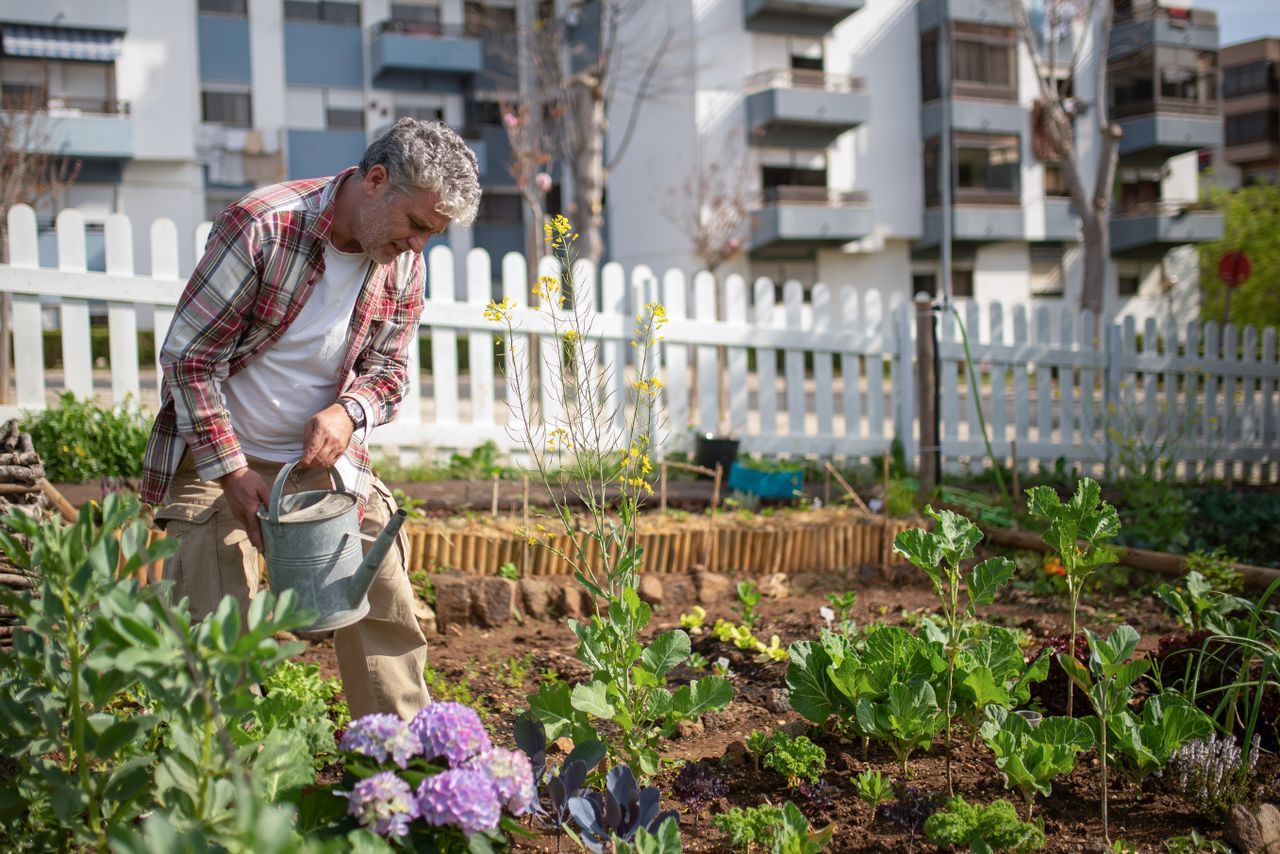
The community garden allotment. You tend your plot. The person in the next plot tends theirs. Over weeks, you nod. Over months, you chat briefly about slugs or weather. No one expects conversation. A 67-year-old reader from Norfolk described his allotment as “the closest thing I have to a social life, which sounds pathetic when I say it out loud. But the bloke two plots over — we’ve never had a conversation longer than five minutes. We’ve never been to each other’s houses. I still look forward to seeing him every Saturday. I don’t know what to call that. It’s not nothing, though.”
That relationship would not pass most people’s definition of friendship. It would not show up on a survey about social connectedness. But for someone whose natural capacity for social contact is small, it can be the difference between feeling entirely invisible and feeling tethered to ordinary life. The categories we use for relationships were not built for people whose needs are quieter. Sometimes the connections that matter most look barely like connections at all.
Regular dog-walking routes at the same time each day. The same faces appear. Recognition builds. Brief exchanges happen naturally at a pace you control.
A recurring seat at the same cafe, library, or community space. The guide to becoming a regular somewhere after 60 covers this in detail — the mechanism of showing up reliably until staff and other regulars begin to recognise you.
Low Energy: Side-by-Side Activity With a Small Fixed Group
These involve being with people around a shared task. Conversation is secondary to the activity itself.
Walking groups suit introverts well because movement and landscape carry the experience. Silence is natural. Conversation comes and goes without anyone needing to generate it. Groups under twelve people with a regular schedule and consistent membership work best.
Repair cafes and maker spaces where you work alongside others on a practical project. The focus is the task. Interaction happens at the edges.
Hobbies with a built-in social format — pottery, life drawing, woodworking — where the group size is small and attention is directed at the craft rather than at each other.
Medium Energy: Structured Interaction With Clear Boundaries
These involve conversation, but within a defined format that removes the burden of generating interaction from nothing.
Volunteering with a fixed team and a practical role. Working a regular volunteer shift at a charity shop, food bank, or conservation project gives you a reason to talk that is not personal. The task provides shared material. You are useful, not performing.
Community groups with a clear agenda — local history societies, amateur naturalist groups, civic committees. These have a defined start and end time, a topic, and a structure. You can participate at whatever depth feels comfortable.
Small, focused classes (under twelve people) with a learning objective. Language classes, art workshops, or instrument lessons where the teacher carries the session and social interaction is incidental rather than the point.
What “Enough” Looks Like When You Are Not Naturally Social
You will encounter articles citing statistics about loneliness and health: the 43% of adults over 45 who report feeling lonely, the links between social isolation and cognitive decline, the increased mortality risk. These numbers are real. They are also routinely used to make people feel guilty about preferring solitude.
Here is a more useful frame: the research on loneliness measures subjective dissatisfaction with your social life, not the objective amount of social contact you have. A person with one close friend and two pleasant weekly interactions may score as not lonely at all. A person attending five social events a week and feeling disconnected at every one may score as deeply lonely.
There is something else worth naming here, because no one does. Some people discover, after making genuine effort, that they were not actually lonely. They were told they should be. The cultural pressure to be social in retirement is strong enough that people sometimes mistake guilt for loneliness. If you try one activity for two months and find that what you feel afterward is relief at coming home rather than warmth from connection, that tells you something real. You may have been solving a problem that was not yours to begin with.
For people who are not naturally social, “enough” is not a number of activities or a frequency of contact. It is the absence of that specific ache — the sense of being genuinely unknown to anyone outside your family. If you have one or two people who know your current life (not your history, your current life), you are likely meeting your own minimum. If you do not, one regular commitment sustained over months is usually what changes that.
I would steer most people in this position toward one commitment, not three. One weekly activity, chosen for low energy cost and high familiarity accumulation. Attend it for at least two months before assessing whether it is working. If after eight weeks you recognise faces and they recognise yours, something is building. If building a social life from near-zero describes your situation more accurately, that guide covers the full staged approach.
Frequently Asked Questions
How do introverts meet people after retirement without forcing themselves?
Through structured, side-by-side activities where conversation is secondary to a shared task. Walking groups, community gardens, volunteer shifts, and small craft classes all allow connection to build through proximity and repetition rather than social performance. The key is choosing something low-energy enough to sustain weekly without dreading it.
Is it normal to not want a big social life in retirement?
Yes. Preferring a small social world is a personality trait, not a deficiency. Research shows that interaction quality predicts wellbeing far more reliably than interaction quantity. Some people genuinely thrive with one or two close connections and a handful of pleasant acquaintances. The concern is not wanting solitude — it is noticing that you have no one who knows your current life and feeling the gap.
How much socializing do retired introverts actually need?
There is no universal threshold. The useful question is whether you feel genuinely known by at least one person outside your immediate family. If yes, your current level may already be sufficient. If not, one regular weekly commitment sustained over several months typically begins to produce that sense of connection. You do not need to fill a social calendar.
What are low-pressure ways to meet people when you are naturally quiet?
Activities where the focus is a task rather than conversation: community gardening, walking groups, repair cafes, volunteering with a physical job, small art or craft classes. These settings allow interaction to happen at the edges rather than requiring you to generate it. The smaller and more stable the group membership, the better.
Can online communities count as real social connection after retirement?
They can supplement it, particularly for people who find text-based interaction more sustainable than face-to-face socialising. Online groups built around a shared interest — a gardening forum, a photography community, a local neighbourhood group — can provide the sense of being known and recognised. They work best as a complement to at least one in-person recurring commitment, however modest, because physical proximity still builds familiarity differently from digital contact.
A Quiet Starting Point
Some readers will finish this guide and decide to try one small thing. Others will recognise that their current solitude suits them better than they had been led to believe. Both conclusions are equally useful.
If you do want to try something, the simplest filter is this: choose the activity you could attend weekly for two months without cancelling because you dread it. Not the one that sounds most productive or most impressive. The one whose energy cost feels genuinely manageable. Show up regularly, and let familiarity do the work that personality never needed to.
Knowing that group dinners drain you but adjacent-plot gardening does not, or that you prefer one conversation over coffee to a room full of friendly strangers, is not a limitation. It is specific enough self-knowledge to shape every future decision — including, eventually, whether companionship or dating is something you want to move toward, on your own terms and at your own pace.