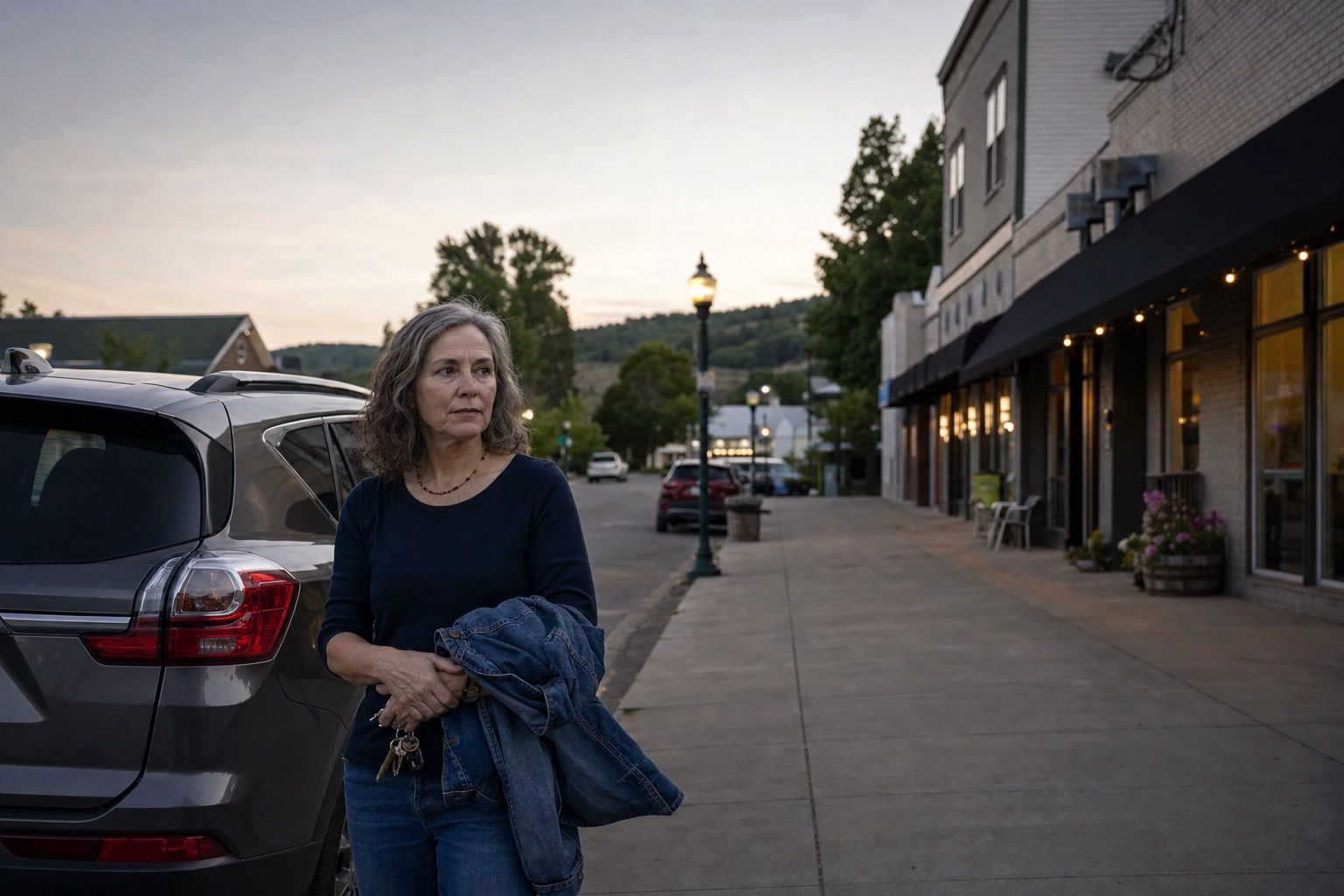
Editorial note: This guide draws on reader feedback from singles over 50 in smaller cities and rural areas who described opening dating apps and finding them conspicuously quiet — few profiles, fewer responses, and the particular discouragement of feeling overlooked by platforms that seem designed for denser populations. We have no affiliate relationship with any platform mentioned here. According to Pew Research Center data (2023), about 17% of Americans aged 50 and older have used a dating site or app, with usage dropping further among those in their 60s and 70s. When that already-modest adoption rate is spread across a low-density geography, the resulting experience can feel genuinely empty — and that emptiness is structural, not personal.
You opened the app expecting something — not fireworks, not instant chemistry, but at least some sense that other people were nearby and looking too. Instead you found a handful of profiles, some inactive for months, several clearly outside your age range, and a radius that would require an hour’s drive to produce anyone new.
That is not a reflection of your appeal. It is a reflection of where you live.
One reader in a mid-sized Midwestern city described it plainly: “I cycled through the same twelve faces for three weeks. Some hadn’t updated their profiles in over a year. I started to feel like I was the only person actually on this thing.” Another, in a coastal town of about 40,000, said the app showed her the same people her friends had already met and stopped seeing — a dating pool that functioned more like a closed loop than an open market.
If this sounds familiar, you are not failing at online dating. You are encountering a structural limitation that most app advertising and app-store summaries quietly ignore. For readers still unsure whether the issue is geographic sparsity or something else entirely, the guide to diagnosing whether the problem is the app or your expectations helps separate platform-fit problems from expectation-alignment ones.
Why Some Areas Feel Empty on Dating Apps
The emptiness is not random. Several things converge to make dating apps feel thin in certain areas, and understanding them helps separate what you can change from what you cannot.
Lower overall adoption among older adults. Dating app usage peaks among adults under 40. Among Americans in their 50s, about 23% have tried an app; in their 60s, that drops to roughly 14%. When a platform’s total local user base is already small, even modest adoption differences by age group can reduce the visible pool to a handful of people.
Population density matters more than platform quality. According to industry analyses, urban and suburban residents make up the large majority of dating app users in the United States — a pattern that holds across all major platforms. The same app that shows hundreds of active profiles in a metro area may show a dozen within the same radius in a smaller city or rural county. This has nothing to do with which app you chose — it is a function of how many people live nearby and how many of them happen to be single, age-appropriate, and using the same platform at the same time.
Platform algorithms prioritize engagement. Most dating apps surface profiles in part based on recency and activity. If few people near you are logging in regularly, the app has less to show you — and may start widening its own radius silently or recycling profiles you have already seen. The experience of “seeing the same people again” is often the algorithm running out of fresh options, not a sign you have done something wrong.
Niche apps fragment an already thin market. In areas with low overall adoption, choosing a niche platform — even one marketed specifically at older adults — can reduce the visible pool further. A senior-focused app with 500,000 national users distributes very thinly across rural counties. Mainstream platforms with larger overall user bases sometimes produce more local activity even in smaller areas, simply because their scale compensates for geographic spread.
Seasonal and time-of-day patterns. In some areas, app activity fluctuates with seasonal patterns — retirement migration, snowbird movement, holiday periods. A week in February may look dramatically different from a week in October. If you tried an app once during a quiet stretch and concluded it was dead, the picture may not be complete.
What an Empty App Is Actually Telling You
An empty app is information, not a verdict.
It is telling you something specific about the overlap between your location, your age group, and the platform you chose. It is not telling you that you are undateable, that your area contains no interesting single people, or that you left it too late.
The distinction matters because the emotional weight of staring at an empty screen is real. When the app shows nothing — or worse, when it shows a few people you know are wrong for you and then quietly stops producing new options — it is easy to internalize that emptiness as a statement about your value. Especially after 50, when the cultural messaging already suggests that your window is narrowing.
But what an empty app is actually showing you is a supply problem, not a desirability problem. The supply of active, age-appropriate, geographically close users on that specific platform at that specific time is low. That tells you something about the platform and the location. It tells you nothing about what you have to offer.
If you have been wondering whether paying for a premium subscription would help with this, the answer in most cases is: probably not. A subscription may let you see who liked you or unlock filters, but it does not create new users in your area. If the free tier showed very few people nearby, the paid tier will show the same few people with slightly different tools for reaching them. The guide to whether paid dating apps are worth it after 50 addresses this directly.
Practical Responses That Do Not Require Reinventing Your Life
None of these responses require moving, changing who you are, or pretending to enjoy something you find exhausting. They are adjustments — things you can try without overhauling your life or treating dating as a project that demands optimization.
Try a broader platform before giving up on apps entirely. If you have been using a niche senior dating app, try one with a larger overall user base — Match or Bumble, for instance. In areas with low density, the platform with the most total users often produces the most local activity, even if it is not specifically designed for your age group. Facebook Dating is worth considering in thin areas — it draws from Meta’s enormous user base and is completely free, which means higher local activity in many regions. The Facebook Dating review for singles over 50 covers the trade-offs. The guide to choosing the right dating app after 50 includes a section on pool size as a selection factor.
Widen your radius deliberately, not desperately. Most apps let you set a distance range. If your current radius is 15 miles and showing nothing, try 30 or 40 before concluding the area is empty. An extra twenty minutes of driving may not feel ideal, but it may also be the difference between an empty screen and a handful of real possibilities. The question is not “how far am I willing to drive every day?” — it is “how far would I drive for a first coffee if someone genuinely interesting appeared?”
Reduce to one app. If you have been spreading yourself across three platforms, each of which shows almost no one, consolidate. One app with slightly more local activity is more useful than three that each contain four stale profiles. You can always rotate — try a different one next month — but running multiple thin apps simultaneously just multiplies the feeling of emptiness.
Check at different times. Activity patterns in smaller areas can be uneven. Some people only use apps on weekends. Some are more active in the evenings. Some deactivate for weeks and return. If you have been checking at the same time each day and seeing nothing, try varying your schedule before concluding the pool is static.
Lower the tempo without lowering your standards. In a thin area, the right pace may be slower than dating advice typically suggests. You may get one interesting match per month rather than per week. That slower pace is not failure — it is the realistic speed of dating in a lower-density environment. Accepting that pace can reduce the frustration of comparing your experience to advice written for people in major cities.
Consider a broader approach to meeting people. Apps are one channel. In areas where they are thin, they may not be the primary channel. This does not mean you have failed at technology or should abandon it — it means the mix may need to include other things. More on that below.
When Offline Meeting Becomes Part of the Answer
In some areas, dating apps are genuinely insufficient — not because you chose wrong, or because you need to try harder, but because the local supply of active users simply cannot sustain the experience that apps promise in larger markets.
That is worth acknowledging plainly. Not every area has a dating-app solution. Some places are thin, and no amount of radius-widening or platform-switching will change that meaningfully. When this is the case, offline meeting is not a concession or a fallback — it is a practical adaptation to real geography.
Offline does not mean approaching strangers or forcing yourself into uncomfortable situations. It usually means expanding the number of contexts where you encounter new people, some of whom may turn out to be single and interesting:
- Community groups, classes, or volunteer work that naturally introduce you to people your age
- Activities where conversation happens naturally — walking groups, book clubs, cooking classes, local talks or lectures
- Social connections through existing friends who understand you are open to introductions
- Events in a nearby larger town, even if they require a drive
- Travel groups for singles over 50 — a way to meet people outside your local geography entirely, with concentrated social time built in
The comparison of dating apps and offline meeting after 50 explores this in fuller detail. For readers in thin areas, the useful insight from that piece is that offline meeting provides context that apps cannot — you encounter someone in a setting that already tells you something about their energy, interests, and manner. In a small-pool environment, that context can be more valuable than the reach an app offers.
The two paths are not mutually exclusive. You can keep an app open at a low-maintenance, low-expectation level while also expanding the offline channels through which you encounter people. Neither one needs to carry all the weight.
What a Realistic Pace Looks Like in a Thin Area
Most dating advice assumes a metro-density environment — the kind of place where you might match with several people in a week, schedule a date within days, and maintain two or three active conversations simultaneously. If that is the baseline you are measuring against, a thin area will always feel like failure.
A more realistic expectation for dating in a lower-density environment might look like:
- One or two potentially interesting new profiles per month, not per week
- Conversations that develop more slowly, because both people have fewer options and less urgency
- First meetings that require more logistical planning — longer drives, less spontaneous timing
- Longer stretches between dates that do not indicate failure
- Periods where the app shows nothing new and the correct response is to close it and check back later
This is not settling. It is calibrating. The person you are hoping to meet still exists somewhere. The timeline for encountering them in a thin area is simply longer, and the route may involve more patience and more channels than a single app.
The risk in a thin area is not that you will never meet someone. The risk is that the gap between expectations and reality produces enough discouragement that you stop altogether — or lower your standards out of impatience. Neither is necessary. What usually helps is adjusting the mental model: the process may be slower, more intermittent, and more dependent on ordinary routines than advice written for cities tends to assume.
If the slower pace starts to feel genuinely draining rather than merely slower, the guide on what to do when dating feels exhausting may be useful — not because something is wrong with you, but because sustained low-reward effort needs a different kind of management than sustained high-activity effort.
Frequently Asked Questions
Should I widen my distance radius even if driving an hour feels like too much?
You do not have to set a radius that feels unsustainable. But it may help to think of it in terms of a first meeting, not a daily commute. A forty-minute drive for a Sunday afternoon coffee is a different proposition from a forty-minute drive every weeknight. Set a radius you would tolerate for an occasional first meeting — not the one that feels comfortable for a routine.
Is it worth paying for an app if there are barely any people near me?
Usually not. Subscriptions unlock features — filters, read receipts, extra visibility — but they do not create new users in your area. If the free version showed you a thin pool, the paid version will show the same thin pool with more tools for interacting with it. Pay only if you found someone genuinely interesting on the free tier and the paywall is preventing meaningful contact.
Does a thin area mean I should give up on apps entirely?
Not necessarily, but it may mean reducing what you expect from them. An app in a thin area works better as a low-maintenance background channel — something you check occasionally — than as a primary strategy. Combining it with offline meeting, social expansion, or activity in a nearby larger town often produces a more sustainable overall approach.
What if I have already tried every app and my area is still empty?
Then the area may genuinely be thin for online dating among your age group. That is a structural reality, not a personal shortcoming. The useful response is usually to shift more weight toward offline channels — community involvement, expanded social circles, introductions — and to treat apps as supplementary rather than central. Some seasons and locations simply do not support the kind of app activity that major cities take for granted.
Where That Leaves You
If dating apps feel empty in your area, you now know why — and you know it is not about you.
The practical path forward is usually a combination: try one broader platform, widen the radius to something you would tolerate for a first meeting, expand the offline channels through which you encounter people, and accept a pace that matches your actual geography rather than the pace that city-based dating advice often assumes.
You do not need every channel working at once. You need one or two that feel manageable — and the willingness to let the timeline be what it is, without treating slowness as evidence that you have been left behind.