Editorial note: This guide draws on a 2012 study from Northwestern University’s Journal of Experimental Social Psychology on “enclothed cognition” — the finding that what people wear measurably affects their psychological state and self-perception, not only how others perceive them. It also draws on reader conversations with singles over 50 who described the specific anxiety of choosing clothes for a first date after years away from dating. We have no styling services, affiliate partnerships, or fashion sponsors. The advice here is editorial, not commercial.
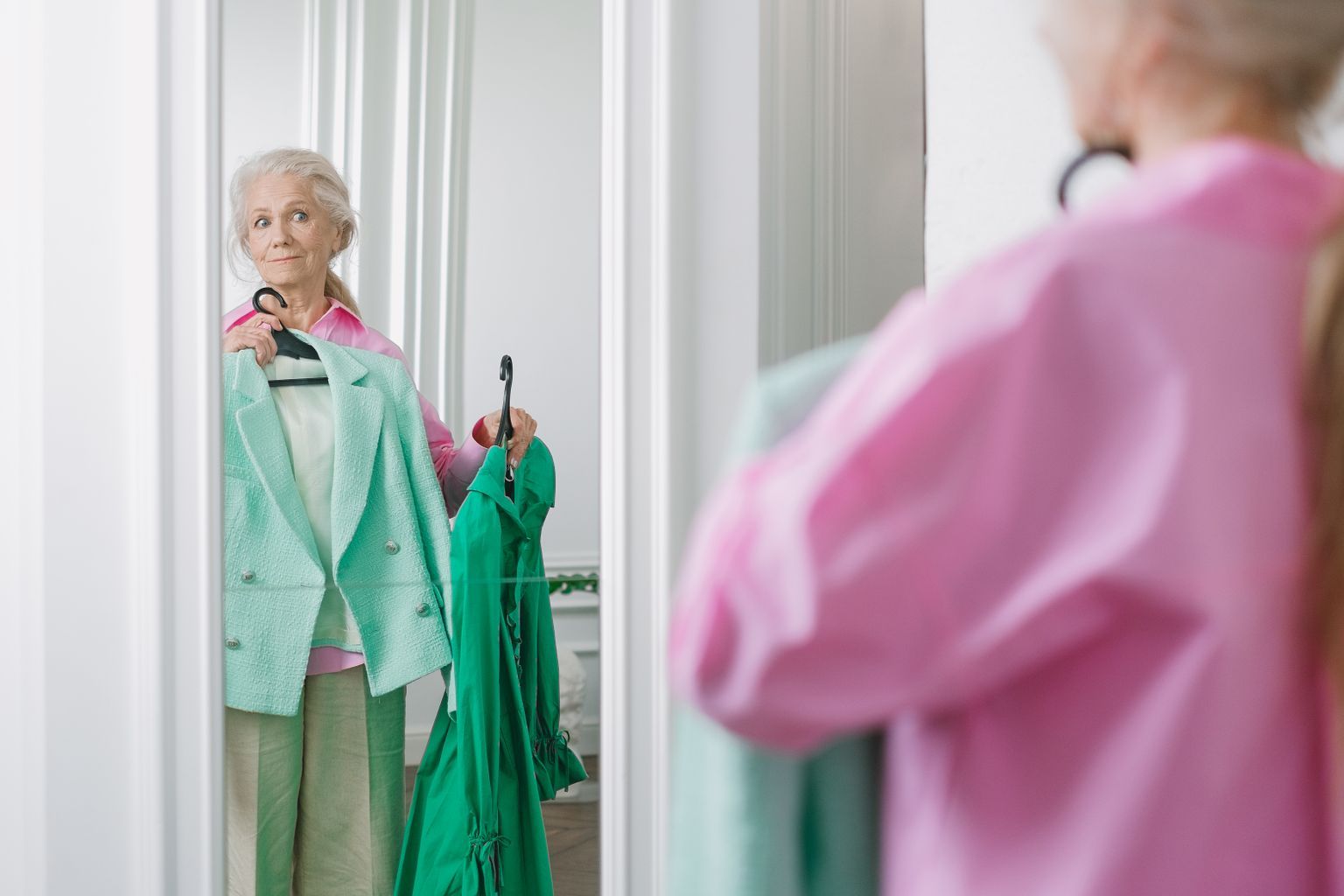
Choosing what to wear on a first date should not take three hours. It should not involve trying on everything you own, rejecting all of it, and arriving late with a low-grade sense that you got it wrong anyway.
And yet, for many people returning to dating after 50, that is roughly what happens. The decision becomes a container for larger anxieties — about whether you still look appealing, whether your clothes are outdated, whether the other person will notice that you have not done this in a long time. The outfit stops being about fabric and becomes about worthiness.
This guide is about shrinking that decision back down to a manageable size. Not because what you wear does not matter at all, but because it matters less than your anxiety is telling you it does — and there are simpler ways to arrive at a good-enough answer without the spiral.
If you are still working on the broader nervousness of showing up for a first date after a long break, How to Handle Feeling Rusty on a First Date addresses that directly. This article is narrower: what to put on your body so you can stop thinking about it and focus on the person across from you.
Why This Decision Feels Harder Than It Should
The clothing question tends to absorb more weight than it deserves for a few specific reasons, most of which have nothing to do with fashion.
Your reference points may be outdated. If you were last dating in your thirties or forties, your sense of what “dressing for a date” means may come from a different era, a different body, or a different relationship context entirely. You may not have bought clothes with this specific intention in twenty years. The gap between your internal image and your current wardrobe creates a kind of static that makes every option feel wrong.
The decision is happening under emotional load. You are not choosing an outfit in a neutral state. You are choosing it while also managing anticipation, self-consciousness, and the vague fear that the whole evening might go badly. Under that kind of pressure, minor decisions feel large. A shirt that would be perfectly fine on an ordinary Tuesday becomes a referendum on whether you are still attractive. If that feeling runs deeper than the clothing decision — if it is really about not feeling attractive on dating apps after 50 — the problem is not the outfit.
You are trying to communicate something you cannot quite name. Most people going on a first date want to look like themselves, but a slightly polished version. The difficulty is that “polished but natural” is a moving target, and it is hard to hit when you are also unsure what version of yourself you are trying to present.
Nobody told you the rules changed. Dress codes have loosened considerably. What counted as appropriate first-date clothing in 2005 may feel overdone now, but nobody sent a memo. The uncertainty about whether you are overdressed or underdressed adds another layer to an already loaded choice.
The result is that people spend disproportionate time and anxiety on a decision that is, in practical terms, fairly forgiving. Most first dates after 50 happen in casual settings — coffee, a walk, a weeknight restaurant — where the range of appropriate clothing is wide and the consequences of an imperfect choice are minimal.
The Real Job of What You Wear
It helps to be clear about what clothing is actually doing on a first date. Its job is more modest than the anxiety suggests.
It should not distract you. If you spend the first half hour tugging at a waistband, adjusting a collar, or regretting your shoes, the clothes are failing regardless of how they look. Physical discomfort pulls your attention inward at exactly the moment you want to be present with another person.
It should feel like a recognizable version of you. The person across from you will eventually see you in your ordinary clothes. If your first-date outfit is dramatically different from how you normally dress — more formal, more trendy, more studied — it creates a mild disconnect that you may feel as self-consciousness and they may feel as slight unfamiliarity when they see you again.
It should match the setting. This is the simplest and most useful filter. A coffee date asks for something different than a nice restaurant. A weekend walk asks for something different than an evening event. The setting gives you a frame, and most of the overthinking dissolves when you use it.
It should leave enough cognitive space for the actual date. The Northwestern research on enclothed cognition found that what people wear affects their psychological state — but the effect runs through meaning and identification, not just aesthetics. Wearing something that feels like yours — something associated with feeling capable and at ease — does more for your confidence than wearing something objectively more stylish that feels like a costume.
The practical implication: the outfit that makes you feel most like yourself, adjusted slightly for the occasion, is almost always the right answer. The search for a perfect outfit is usually the wrong frame entirely.
A Simple Framework That Reduces the Spiral
If you tend to overthink clothing decisions before a date, a framework helps more than inspiration does. Here is one that works for most settings and most bodies:
Step 1: Start with the setting, not the outfit. Where are you going? What would you normally wear to that kind of place on a day when you felt good about yourself? That is your baseline — not what a dating article tells you to wear, but what already works for you in that context.
Step 2: Adjust one level. Take your normal version of that setting and make one deliberate upgrade. Not a transformation — a single adjustment. A better-fitting shirt. Cleaner shoes. A jacket instead of a jumper. One layer of intention is enough to signal that you showed up on purpose without looking like you agonised over it.
Step 3: Check the physical comfort. Before committing, move in the clothes. Sit down. Reach for something. Walk a short distance. If anything pinches, rides up, restricts, or requires constant adjustment, choose something else. Comfort is not optional on a first date — it is the baseline that everything else depends on.
Step 4: Stop once you have a workable answer. A workable answer is not the same as a perfect answer. It is an outfit that fits, suits the setting, feels like you, and does not require further thought. The moment you have that, stop looking. The spiral begins when you keep searching past “good enough” toward “ideal.”
This framework takes five to fifteen minutes for most people. If it is taking longer, you are probably solving an anxiety problem with a clothing decision, and the clothing will not fix it. The broader guide to first date tips covers the full picture of what actually matters when you show up.
What Works for Most First Dates After 50
Specific advice depends on setting, season, and personal style. But there are a few patterns that tend to work reliably across most casual and semi-casual first-date contexts — the kind where you are meeting for coffee, lunch, a drink, or a walk.
For a daytime coffee or walk
The register here is relaxed but intentional. You are not dressing up. You are dressing like someone who cares enough to have thought about it for a few minutes.
What tends to work: well-fitting dark jeans or trousers, a clean shirt or blouse in a solid colour, comfortable shoes you can walk in, and one layer that adds a bit of structure — a blazer, a light jacket, a cardigan with some shape to it.
What tends not to work: anything you would wear to clean the house, anything you would wear to a wedding, or anything that requires constant management.
For an evening restaurant or bar
Slightly more intention, but the same principle applies: one step above your everyday, not a transformation.
What tends to work: a good pair of trousers or a skirt you feel comfortable sitting in, a top with a bit more polish than your daytime options, shoes that feel deliberate but do not hurt after an hour, and — if you want it — one simple piece of jewellery or a watch that makes you feel put together.
What tends not to work: anything so formal that it signals a different kind of event, or anything so tight or structured that you cannot eat comfortably.
The universal principle
Across every setting, the common thread is this: the clothes should recede. Once you have put them on and left the house, you should be able to forget about them. If you cannot forget about them — if they keep pulling your attention — they are the wrong choice regardless of how they look.
Common Overthinking Traps and What to Do Instead
Most first-date clothing anxiety follows predictable patterns. Recognising them can short-circuit the spiral before it takes hold.
The “nothing looks right” loop. You try on multiple outfits, reject each one, and end up feeling worse than when you started. This is almost never a wardrobe problem. It is a confidence problem wearing a wardrobe disguise. The fix is to choose the first option that met the basic criteria — fits, suits the setting, feels physically comfortable — and commit to it. The fifth option will not feel better than the first. Your nervous system is not going to let any outfit feel perfect right now.
The age-appropriate anxiety. A background worry that your clothes are either too young or too old for dating. Too trendy and you look like you are trying. Too conservative and you look like you have given up. This binary is false. There is an enormous range between “trying to look thirty” and “dressing for invisibility.” Most people already live in that range daily. Trust your ordinary taste more than your dating anxiety.
The body comparison trap. You focus on what your body looks like in the clothes rather than how the clothes feel on your body. The shift from evaluation to sensation is the most useful one you can make. A body that has lived fifty or sixty or seventy years does not need to look like it did at thirty-five. It needs to be comfortable, warm enough, and free to move. Those are clothing problems with clothing solutions — better fit, softer fabric, the right layer.
The “what will they think” spiral. You try to predict what the other person will notice, judge, or prefer. This is unanswerable before the date happens. Most people — especially people also over 50 — are paying far more attention to how they feel in your company than to what you are wearing. A reader who spoke with us about her first date after divorce at 57 put it simply: “He never mentioned my outfit. He mentioned that I laughed easily and seemed comfortable.”
The last-minute change. You had a workable outfit, put it on, felt fine, and then changed at the last moment because doubt crept in. The late change almost always makes things worse, because you arrive in something you have spent less time with and feel less settled in. If you were fine five minutes ago, you are still fine.
When You Genuinely Do Not Know What to Wear
Sometimes the issue is not overthinking. It is a genuine gap — your wardrobe has not been updated in years, nothing fits well, or you honestly do not know what is appropriate for the context you are entering.
If that is the case, a few modest steps help more than a full wardrobe overhaul:
Ask someone you trust. Not for fashion advice, but for a reality check. “Does this work for coffee with someone new?” is a question most friends can answer in thirty seconds. The outside perspective often resolves what internal deliberation cannot.
Buy one reliable piece. Not an outfit — a single item that fits your body now and makes you feel slightly more deliberate than your daily default. A good shirt. A well-cut pair of trousers. A jacket with some structure. One piece that works becomes an anchor for the rest.
Match the formality to the venue. If you are genuinely unsure, look at what other people wear to that kind of place. A quick visit to the café or restaurant in the days before your date gives you a visual baseline that removes the guesswork.
Give yourself a time limit. Decide in advance that you will spend no more than fifteen minutes choosing. Set the limit before you open the wardrobe, not after you have been standing in front of it for forty-five minutes. The limit is a boundary against the anxiety, not against the decision.
If none of this resolves the discomfort, the problem may be less about clothing and more about how you feel about returning to dating in general. How to Rebuild Social Confidence Before Dating addresses that broader question, and First Date Tips for Mature Singles covers the practical logistics of the date itself.
The Clothes Are Not the Point
What you wear on a first date after 50 matters in the same way that choosing a comfortable chair matters before a long conversation. It creates conditions. It does not determine outcomes.
The person across from you is not grading your outfit. They are noticing whether you seem present, whether you are easy to talk to, whether there is a quality of attention between you that makes the hour feel worthwhile. Clothes can support that by keeping you comfortable and out of your own head. They cannot substitute for it.
So choose something that fits. Choose something that suits the place. Choose something that feels like a version of you that you do not mind being seen in. And then stop choosing, because the date is not about the clothes — it is about what happens after you forget them.