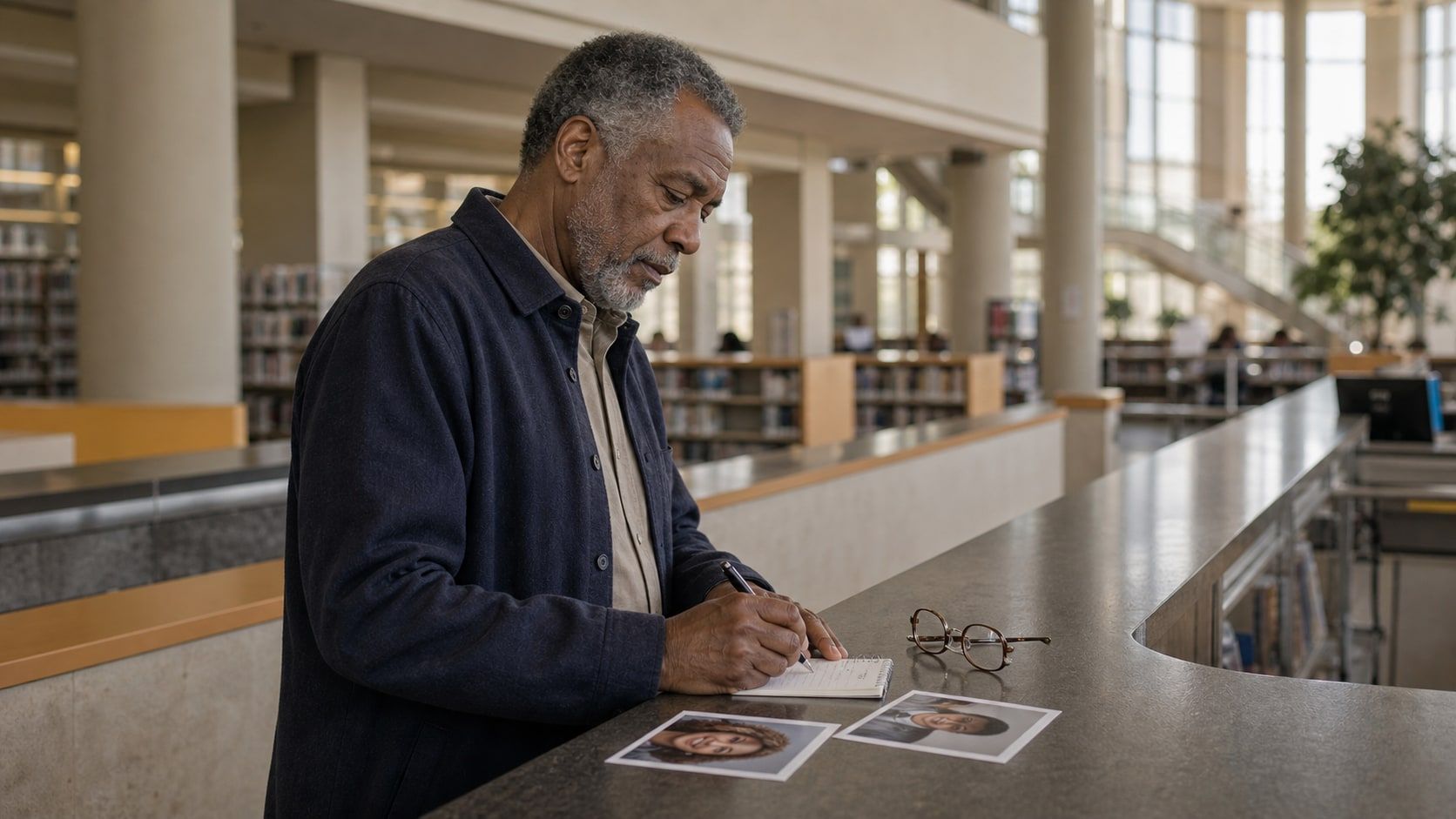
Editorial note: This guide addresses AI-powered catfishing on dating apps — a growing category of romance fraud that uses artificial intelligence to generate fake photos, automate conversations, and impersonate people. The FTC reported that Americans lost over $1.14 billion to romance scams in 2023, and industry observers note that AI tools are making these operations cheaper, more scalable, and harder to detect. This guide does not cover every type of dating scam. It focuses specifically on the AI dimension — the signs that a profile, a conversation, or a video call may be machine-generated rather than human.
What AI Catfishing Actually Is
AI catfishing on dating apps after 50 combines traditional romance fraud with artificial intelligence tools. Instead of a scammer manually writing messages and stealing photos from social media, AI catfishing uses:
AI-generated profile photos. Tools can create photorealistic images of people who do not exist. These faces look real, photograph well, and cannot be found through a standard reverse image search — because they were never photographed. They were computed.
Chatbot-driven conversations. Large language models can now maintain coherent, emotionally engaging text conversations for days or weeks. A single operator can run dozens of simultaneous “relationships” using AI to handle the messaging, with human intervention only at key extraction points.
Deepfake video. Some operations use real-time face-swapping technology during video calls, making it appear as if the person in the profile photo is actually on the screen. The quality varies, but it is improving rapidly.
The combination of these tools means that the traditional advice — “do a reverse image search” or “insist on a video call” — is no longer sufficient on its own. Both defences can now be circumvented by a sufficiently equipped operation.
How to Spot an AI-Generated Profile Photo
AI-generated faces have improved dramatically, but they still leave traces. Here is what to look for:
Symmetry that feels uncanny. Real faces are slightly asymmetrical. AI-generated faces tend toward unusual perfection — both sides matching too closely, skin too smooth, lighting too even across the entire face.
Background anomalies. The face may look flawless while the background contains warped lines, melting objects, inconsistent architecture, or blurred text that does not quite resolve into words. AI often prioritises the face at the expense of everything around it.
Hair and ear irregularities. Look at where hair meets the background, especially around the ears. AI frequently produces hair that fades into blur, earrings that differ between ears, or ear shapes that look slightly melted or asymmetrical in unnatural ways.
Teeth and hands. These remain difficult for AI. Teeth may have unusual numbers, uneven sizing, or blurred boundaries. Hands — if visible — may show extra fingers, merged digits, or impossible joint angles. These errors are less common in 2025 than they were in 2023, but they still appear.
Consistency across multiple photos. Ask to see more than one photo. AI-generated profiles often struggle with consistency — the person may look subtly different in each image (slightly different nose shape, different skin tone, inconsistent ageing). Real people look recognisably like themselves across photos taken months or years apart.
One technique that still works: Take a screenshot of the profile photo and upload it to a reverse image search (Google Images, TinEye). If the exact image appears nowhere else online — no social media, no LinkedIn, no tagged photo — that is not proof of AI generation, but it reduces the likelihood that the person has a normal digital footprint. For a detailed walkthrough, the guide on how to reverse image search a dating profile covers the process step by step.
How to Recognise AI-Generated Conversation
Chatbot-driven romance scams have a distinct texture once you know what to notice:
Responses that are fast and long. A real person over 50, typing on a phone, does not produce three paragraphs of perfectly structured prose within two minutes of receiving your message. Unusually rapid, lengthy, well-formed responses — especially late at night or across time zones — suggest automation.
Flattery without specificity. “You have the most beautiful smile” or “I feel such a deep connection with you” are easy for any chatbot. What AI struggles with is remembering and referencing specific details you shared three days ago, making jokes that require cultural knowledge of your specific area, or responding to an unusual statement with genuine surprise rather than a smooth pivot.
Perfect grammar in unexpected contexts. A profile claiming to be a retired tradesperson or someone whose first language is not English — but who writes with the polished fluency of a professional writer — is worth questioning. The mismatch between claimed identity and communication style is often the clearest signal.
Inability to go off-script. Try introducing something unexpected: a strange hypothetical question, a niche reference to something from your town, or a deliberate factual error about yourself to see if they notice. Chatbots handle predictable romantic conversation well. They handle randomness, humour, and contradiction poorly.
Avoidance of specifics about their own life. When you ask concrete questions — “What was your commute like today?” “What did you have for dinner?” “What is the weather like where you are?” — a real person answers with boring specifics. A chatbot tends to redirect back to you or offer vague, emotionally warm non-answers.
The “always available” pattern. A person who responds within minutes at all hours, never has a busy day, never sends a distracted or short reply, and never says “sorry, I was in the shower” — is worth questioning. Real people have rhythms. Chatbots do not.
The Deepfake Video Problem
The traditional advice was: “Insist on a video call before meeting. If they refuse, it is probably a scam.” That advice is no longer airtight. The broader question of whether you should video call before a first date after 50 still matters, but it now needs to be treated as one signal rather than definitive proof.
Deepfake technology can now overlay a different face onto a real person during a live video call. The quality ranges from obvious (flickering edges, lag between lip movement and audio) to convincing (smooth, real-time, indistinguishable at standard webcam quality).
Signs of a deepfake video call:
- Face edges that shimmer or blur, especially when the person turns their head
- Inconsistent lighting between the face and the background or body
- Lip sync slightly off from the audio
- Reluctance to raise a hand near the face (this disrupts many deepfake systems)
- The face appears sharper or better-lit than the rest of the image
- Brief glitches when they move quickly or if their hand passes over their face
A practical test: During a video call, ask them to do something that disrupts face-tracking: hold a hand briefly over their chin, turn sideways, or hold an object near their face. Many deepfake systems glitch visibly when the face is partially occluded.
The honest reality: A skilled operation using high-quality deepfake tools can fool most people on a standard video call. If your only evidence that someone is real is a single video call, supplement it with other verification — mutual connections, specific local knowledge, willingness to meet in person within a reasonable timeframe.
Why Older Adults Are Targeted
Adults over 50 are disproportionately targeted by romance scams, and AI makes these operations more scalable. The reasons are structural, not a reflection of anyone’s intelligence:
Financial profile. People over 50 are more likely to own property, have retirement savings, and have access to funds. Scammers optimise for return on investment.
Emotional availability. Post-divorce loneliness, bereavement, or years of isolation create genuine emotional gaps. AI-powered conversations are designed to fill exactly these gaps — offering attention, consistency, and emotional engagement that feels rare and valuable.
Unfamiliarity with AI capabilities. Many people over 50 have not personally used AI text tools or image generators. Without firsthand experience of what AI can produce, the outputs are harder to recognise as synthetic.
Trust patterns. People who grew up before widespread digital manipulation tend to trust visual evidence (photos, video) more than people who grew up editing and filtering their own images. A photorealistic AI face carries more persuasive weight for someone who assumes all photos depict real people.
None of these factors make anyone foolish. They make the targeting effective — which is why awareness matters.
What to Do If You Suspect AI Catfishing
Do not confront immediately. If you suspect someone is an AI-operated profile, gathering information is more useful than an accusation they will simply deny or disappear from.
Run checks quietly. Reverse image search their photos. Check whether their stated location matches their timezone and weather. Note inconsistencies in their story. Save screenshots of the conversation.
Test with specificity. Ask questions that require local knowledge, personal memory, or spontaneous thought. “What is the coffee shop nearest your apartment?” “What was the last book you read?” “Tell me something embarrassing that happened to you last week.” Observe whether the answers feel lived or constructed.
Suggest a meeting. A real person who lives nearby and is genuinely interested will eventually agree to meet in person. Endless deferral — always a reason they cannot meet this week, next week, next month — is itself a signal regardless of the AI question. If you are unsure about the timing, the guide on when to move off the app to text or meet in person can help you calibrate what “reasonable” looks like.
Report and block without guilt. If you conclude the profile is fake — AI-generated or otherwise — report it to the platform and block without explanation. You owe nothing to a machine or to the operator behind it.
For a broader framework on verifying whether a dating profile is real, that guide covers the general verification process. For recognising sob stories and financial extraction patterns, that guide covers the typical script once emotional investment is established.
Staying Safe Without Becoming Cynical
The goal of awareness is not to make you suspicious of everyone. It is to give you enough information to notice when something does not fit — so that the genuine connections you make can be trusted more fully because they survived reasonable scrutiny.
Most people on dating apps are real. Most conversations are human. Most interest is sincere. But the minority that is not has become more sophisticated, and the old rules for detecting it need updating.
The practical posture is: trust people who earn trust through consistency, specificity, willingness to meet, and behaviour that matches their words over time. Be cautious of anyone who offers intense emotional connection without any verifiable anchor in the real world.
For a broader foundation on online dating safety after 50, that guide covers the full landscape of staying safe while remaining open to connection.
A Manageable Starting Point
If you are using dating apps and want to stay aware of AI catfishing without becoming paranoid, three habits cover most of the ground:
- Reverse image search profile photos before investing significant time in a conversation
- Pay attention to conversation texture — speed, specificity, ability to go off-script, and whether the person remembers and references what you have shared
- Propose a meeting within a reasonable timeframe — and take note if the deferral pattern becomes indefinite
You do not need to become a deepfake detection expert. You need to notice when a connection lacks the ordinary imperfections, inconsistencies, and mundane specifics that real human life contains.