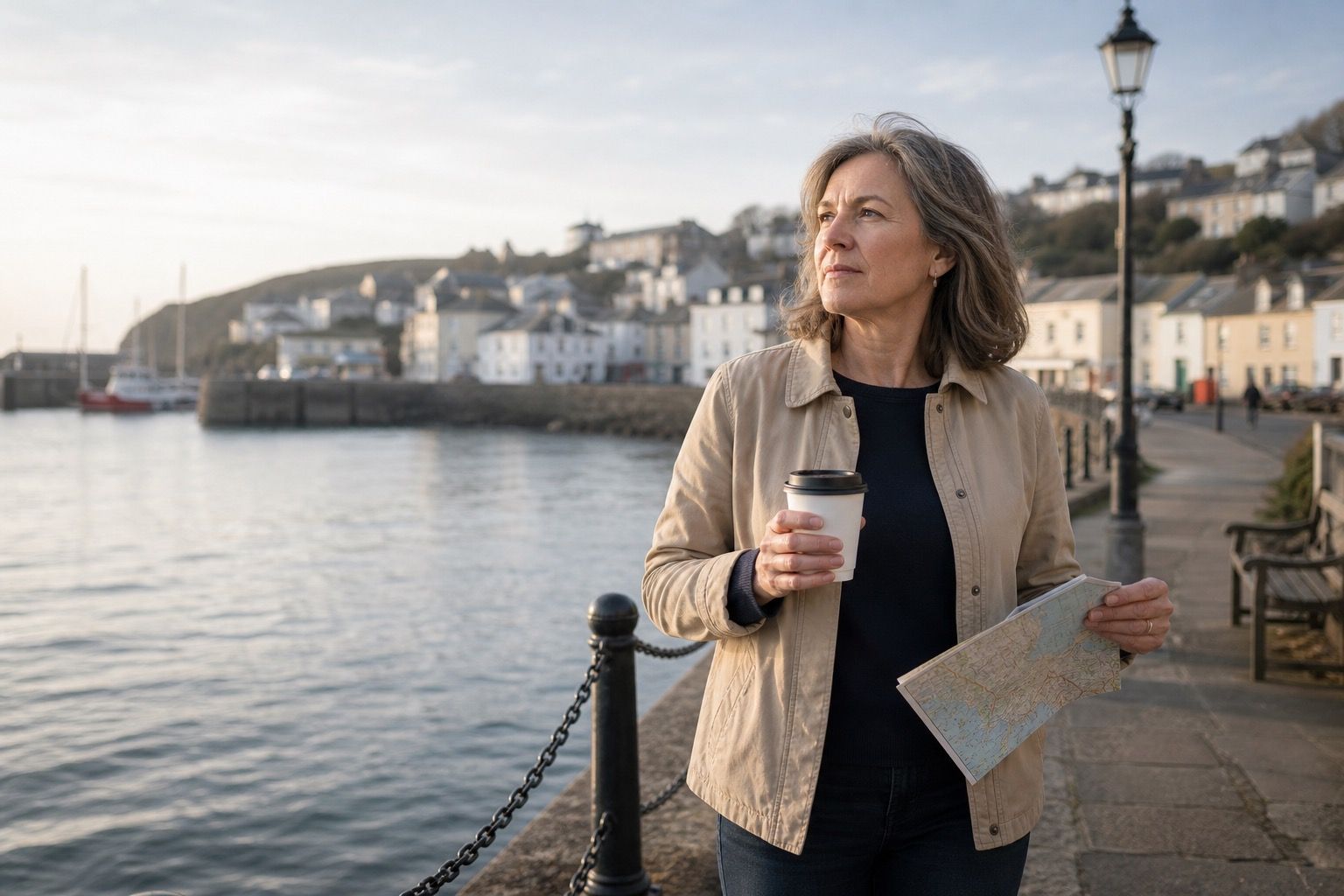
This story is a composite based on experiences shared by several readers who relocated in their 50s and navigated dating without an established local network. Names, locations, and identifying details have been changed, but the emotional arc — the specific loneliness of being unknown, the slow process of building familiarity from nothing — reflects what was described to us. Relocation after 50 is increasingly common: U.S. Census data shows that approximately 4.5 million Americans aged 55+ move to a different county each year, and the pattern has accelerated since remote work and early retirement expanded during the pandemic years.
The woman at the center of this story — we will call her Margaret — moved to a mid-sized coastal city three months after retiring. She was 54. The move made practical sense: a smaller house, lower costs, closer to her sister. On paper it was sensible. In practice it meant waking up every morning in a place where nobody knew her name.
Margaret had lived in the same town for twenty-two years. She had not loved everything about it, but she had belonged there in the way that accumulates without effort — the barista who remembered her order, the neighbour who waved from across the road, the Tuesday evening choir that she attended more for the company than the singing. None of that had felt remarkable until it was gone.
The move was not a crisis. She had chosen it. But choosing something and being ready for how it feels are not the same thing. What Margaret felt, in those first weeks, was a kind of low-grade exposure she had not anticipated. Not loneliness exactly. More like being visible and invisible at the same time — present in a place that had no memory of her.
She was not unhappy. She was unanchored. And the difference between those two things turned out to matter more than she expected.
When Routine Has to Be Built From Nothing
In her old town, routine had been inherited. The same supermarket, the same walking route along the canal, the same cafe where she read the paper on Saturday mornings. She had not built those habits deliberately. They had formed over years, layered on top of each other until they felt like the shape of her life.
Here, everything required a decision. Which cafe. Which route. Which supermarket aisle to start with. The decisions were small and individually meaningless, but together they produced a kind of fatigue she had not expected. Every errand was an act of orientation rather than habit.
She found a cafe she liked after trying three. It had wooden tables, a view of the harbour, and staff who were friendly without being performative. She went back twice in the same week and felt faintly self-conscious about it, as though she were trying too hard to establish something that should happen naturally.
The walking was easier. The coastal path did not require social negotiation. She could move through the landscape without needing to be known by it. But even there, she noticed the absence of familiarity — no landmarks that carried personal memory, no stretches where she could think, this is where I always see the heron, or this is where the path floods in winter. The place was beautiful and entirely indifferent to her.
What she missed most was not company in the obvious sense. It was the texture of being recognised. The small, unremarkable exchanges that happen when you have been somewhere long enough to be part of its background. A nod from the postman. A brief conversation at the pharmacy. The sense that your presence registers, even lightly, in the fabric of a place.
Without that, the days felt competent but thin. She was managing. She was not struggling. But she was aware, in a way she had not been before, of how much of her previous social confidence had been environmental — built into the place itself rather than carried inside her.
The Overlap Between Loneliness and Readiness
The thought arrived without announcement. Margaret was sitting in the harbour cafe on a Thursday afternoon, reading and half-listening to the couple at the next table discussing weekend plans, when she noticed a feeling she could not immediately name. It was not envy. It was something closer to curiosity — a quiet awareness that she would like to be making plans with someone, and that the someone did not yet exist in her life here.
She had friends. Her sister lived twenty minutes away and they saw each other most weeks. She spoke to old friends on the phone. But those relationships, however warm, did not fill the particular gap she was beginning to notice — the gap that opens in the evenings, in the unstructured hours, in the space between finishing dinner and deciding it is late enough to go to bed.
What confused her was that she could not tell whether she wanted a friend or something more. The two needs felt tangled together in a way they never had in her old life, where friendship and romantic companionship had occupied separate, clearly marked territories. Here, where both were absent, the boundary between them blurred. She wanted someone to walk with. She wanted someone to talk to over dinner. She wanted someone who might, eventually, know her well enough that she did not have to explain everything from the beginning.
Whether that meant dating or simply deeper friendship, she genuinely did not know. And she suspected the answer might not matter as much as the willingness to be open to either.
She had read, in passing, that readiness to date after 50 often arrives unevenly — not as a clean decision but as a gradual shift in attention. That matched what she felt. She was not ready in any declarative sense. She had not decided anything. But she had stopped being entirely closed to the question, and that shift, small as it was, changed the quality of her days. She noticed people differently. She paid attention to conversations she might previously have let pass. She was not looking. But she was no longer not looking either.
Trying to Meet People When You Have No Context
The practical problem was simple and unromantic: she did not know anyone. Not in the way that supports the kind of gradual, low-pressure social life from which connection — romantic or otherwise — might eventually grow.
In her old town, she had met people through years of overlapping contexts. The choir. Her children’s school, long ago. Neighbours who became friends through proximity and time. A book group that started as an obligation and became something she looked forward to. None of those things had required courage. They had required only presence and patience.
Here, every social step required initiative, and initiative felt heavier than it should have. She joined a local art class — watercolours, Wednesday mornings — because it seemed manageable and because she had always meant to try. The class was pleasant. The other women were friendly. But after six weeks she had exchanged phone numbers with no one, and the friendliness remained contained within the two-hour session, evaporating the moment she stepped back onto the street.
She tried a coastal walking group advertised on a community noticeboard. That was better. The format allowed for conversation without the pressure of sustained eye contact, and the shared activity gave the silences a purpose. She began to recognise faces. A woman named Diane walked at a similar pace and they fell into step together most weeks. It was not friendship yet, but it was the early architecture of one — the kind of thing that, in her old life, would have deepened naturally over months without anyone noticing.
The question of dating sat alongside these efforts rather than replacing them. She was aware that some people in her position might go straight to an app, treating the social rebuilding and the romantic question as separate projects. She was not sure she could do that. For her, the two felt connected — as though she needed some minimum level of local grounding before she could meet a stranger for coffee without feeling entirely untethered. She wanted to be able to say where she liked to walk, which cafe she preferred, what her week looked like. She wanted to have a life here before she invited someone into it. Readers who are unsure whether what they want is dating or just steadier company may also find Finding Companionship Later in Life Without Rushing helpful.
Our comparison of dating apps versus meeting people offline after 50 frames the choice as one of temperament and circumstance rather than a universal recommendation. For Margaret, the answer was not either-or. It was sequence. She needed the offline life to exist first, even in fragile form, before the online question felt manageable.
A First Date in a City That Still Feels New
It was Diane, from the walking group, who mentioned it first. Not as a suggestion exactly — more as a passing remark about her own daughter using an app, and how ordinary it all seemed now. Margaret said something noncommittal and changed the subject. But the comment stayed with her, and a few days later she found herself looking at a dating platform on her laptop with the same cautious curiosity she might bring to reading reviews of a hotel she was not yet sure she wanted to book.
She set up a profile on a quiet evening. The process was less painful than she had imagined, though she spent longer than she would admit choosing a photograph. She wrote a few honest sentences: recently moved, still settling in, interested in walking and conversation. She did not mention loneliness. She did not mention the art class. She kept it brief because brevity felt more dignified than explanation.
The beginner’s guide to online dating after 50 she had skimmed weeks earlier had suggested treating the first few exchanges as practice rather than auditions. That framing helped. She exchanged messages with two men over the course of a week. One conversation faded naturally. The other — with a man named Richard, 58, a semi-retired surveyor who had lived in the area for years — moved toward the suggestion of coffee. If you are at that exact threshold yourself, this guide on when to move off the app to text or meet in person is the more practical companion.
They met at a cafe she had only been to once before. That detail mattered more than she expected. In her old town, she would have chosen somewhere familiar, somewhere that already felt like hers. Here, the cafe was as new to her as the man sitting across from her, and the double unfamiliarity produced a faint vertigo she had to consciously steady.
The conversation was fine. Richard was pleasant, unhurried, easy to talk to. He asked about her move and she gave the short version — retirement, practical reasons, her sister nearby. He told her about the town with the casual authority of someone who belonged to it, and she noticed herself listening not just to what he said but to the way he inhabited the place. He had a local life. He had context. She was still building hers.
She did not feel a strong pull toward him. What she felt was something more diffuse: the strangeness of sitting across from someone who had no idea what her life had looked like six months ago, in a town that did not yet feel like home, trying to be present in a moment that had no history underneath it. It was not unpleasant. But it was exposed in a way she had not fully anticipated — like speaking a language she knew well but in an accent that did not yet feel natural.
Afterward, she walked along the harbour wall before going home. The evening was mild. She did not feel disappointed or elated. She felt like someone who had done a slightly brave thing and was now absorbing the ordinariness of it. Richard texted later to say he had enjoyed the coffee. She replied warmly and honestly. She was not sure whether she would see him again, and she was surprised to find that the uncertainty did not trouble her. The question felt open rather than urgent. That was new.
What Belonging Started to Look Like
Months passed. Margaret did not date Richard again, though they exchanged a few more messages before the conversation thinned to nothing. She met one other man through the app — a brief, friendly coffee that confirmed mutual disinterest within half an hour — and then she paused her profile without drama or disappointment. It had served its purpose, which was not to find someone but to prove to herself that the door was not closed.
What changed more visibly was the texture of her ordinary life. The walking group became a fixed point. Diane became a genuine friend — someone she saw outside the group now, for lunch or an afternoon at a gallery. The art class remained pleasant without deepening, and she made peace with that. She found a second cafe she liked, closer to home, where the owner began to recognise her and once asked after her sister without being prompted.
These were small things. She knew that. But they were the things that, accumulated, begin to feel like belonging — not the dramatic kind, not the instant community that relocation articles sometimes promise, but the slow, ordinary kind that builds when you stay in one place long enough for your presence to register.
The dating question did not disappear. It sat quietly alongside everything else, neither urgent nor dismissed. She thought she might reactivate the profile eventually, or she might not. She thought she might meet someone through the walking group, or through Diane, or through no one at all. The story of finding companionship without rushing that she had once read online had described patience not as a strategy but as a temperament, and she recognised something of herself in that framing. She was not waiting. She was simply not forcing.
What she had learned — though she would not have put it in those terms — was that dating in a new city was not really a separate problem from living in a new city. The two were the same project, or at least they shared the same foundation: the slow, unglamorous work of becoming someone who belongs somewhere. You cannot invite another person into a life that does not yet feel like yours. Or perhaps you can, but it costs more than it should.
She was not there yet. Not fully. But the city was becoming familiar in small, accumulating ways — the path she preferred along the coast, the bench where she sometimes sat with coffee, the sound of the harbour in the early morning. And inside that growing familiarity, the idea of sharing some of it with someone felt less like a leap and more like a natural next possibility. Not now, necessarily. But not never either.
That was enough. Not a resolution. Just proportion.