This story is a composite drawn from conversations with several readers who described similar experiences — wanting companionship without upheaval, finding connection through repeated low-pressure contact rather than deliberate dating, and learning to trust a slower pace. Names and details have been changed, but the emotional pattern is real and common. We publish it because the desire for companionship without intensity is one of the most frequently described feelings among our readers over 50 — and one that dating advice rarely addresses directly.
Finding companionship later in life can begin with a wish that is smaller, and more complicated, than people often admit.
It may not feel like a bold desire for romance. It may feel more like noticing that life would be warmer or less solitary if another person were there — not constantly, not demandingly, but present in the way that a familiar voice on a Tuesday afternoon can change the shape of a week.
That wish can coexist with caution. According to the University of Michigan’s National Poll on Healthy Aging, about one in three older adults (33% in 2024) reported feeling a lack of companionship in the past year. The number peaked at 42% during the pandemic years and has since returned to pre-pandemic levels — but “pre-pandemic levels” still means a third of older adults feel this way. The desire is widespread. What is less often discussed is that many of these people do not want a traditional romantic relationship. They want something quieter, more proportionate, and less disruptive to the life they have built.
For the woman at the center of this story, whom we will call Marianne, the difficulty was not deciding whether she still liked people. She did. It was deciding whether there was a version of connection that did not immediately begin asking for too much.
When Wanting Company Does Not Mean Wanting Upheaval
Marianne was 62 and had been living alone long enough for solitude to stop feeling like an interruption and start feeling like a structure. She worked part-time at a local library — three days a week at the reference desk, which she liked because it involved helping people find things without having to make extended conversation. She met a friend for coffee most Thursdays at the same place they had been going for years. She kept a small, competent life running without much fuss.
She liked reading in bed without negotiating with anyone about lamps or noise. She liked the fact that if she wanted to spend a Saturday morning pruning the pots on her patio and then eating toast over the sink at half past ten, the day belonged entirely to her. Her son lived in Oregon and called on Sundays. Her sister was twenty minutes away. She was not isolated. She was simply alone, which is a different thing.
She also knew that liking solitude was not the same thing as wanting to be alone forever. A concert might end with the thought that it would have been nice to have someone beside her — not to discuss the music, necessarily, just to walk back to the car with. A rainy afternoon might feel longer than it needed to.
What made the question difficult was that Marianne did not miss chaos at all. She did not miss monitoring another adult’s moods or feeling obliged to explain every small preference. She had spent enough time building a life she could breathe in. Of course she was protective of it.
That protectiveness can be hard to describe without sounding closed-off. But what she wanted was not control for its own sake. It was proportion. She wanted room for affection to develop without constant contact, fast disclosure, or premature certainty. Our guide to how to start dating again after 50 touches on a similar truth from a more practical angle: wanting connection again does not require a grand reinvention.
A Connection That Began in Ordinary Time
The beginning, when it came, did not look like a beginning.
Marianne met Thomas through repetition, which is how many later-life connections actually start — not through apps or introductions, but through showing up in the same place often enough that familiarity becomes its own kind of introduction. He had recently joined the volunteer group that helped set up monthly used-book sales at the library. At first he was simply another person moving folding tables, sorting hardcovers into fiction and non-fiction, and asking practical questions about where the children’s section went. He was in his mid-60s, wore the same navy fleece most Saturdays, and seemed to understand instinctively that group work goes more smoothly when nobody tries to become the center of it.
For the first few weeks, their conversations were limited to the sort that hardly seem worth naming afterward. Had anyone seen the cash box. Was the weather supposed to turn by afternoon. Marianne noticed him mostly because she did not have to make an effort to speak to him. Some people bring a social demand with them, even when they are trying to be pleasant. Thomas did not.
That mattered more than she realized. Many people imagine companionship beginning with a stronger signal than that. Instead, what caught Marianne’s attention was the absence of strain. Thomas seemed easy to be around in the plainest sense. He did not crowd silence or ask questions that required her to become charming on command. That quality — genuine curiosity without neediness — is often what distinguishes real interest from loneliness-driven contact. For readers still deciding whether they even want to open that door again, How to Start Dating Again After 50 covers the earlier, more practical side of that question.
Over time, the small exchanges lengthened. One Saturday, after the sale had ended and the last boxes were being taped shut, the two of them stood outside near the donation bin and kept talking longer than necessary. Not intensely. Just long enough for Marianne to notice, with some surprise, that she was not watching for the moment when she could politely leave.
Even then, she did not go home thinking, This may become something. She went home thinking, That was pleasant. The modesty of that response turned out to be important. She did not begin building a story around him. She simply let familiarity accumulate.
The next month, he was there again. Then the month after that. Marianne found that she looked for him in the room, though not anxiously.
There is a kind of reassurance in that, especially later in life. Not every connection needs to announce itself in order to matter. Sometimes what makes a person noticeable is not intensity but the absence of pressure. For Marianne, that was the first useful sign that whatever this was, it did not seem to be asking her to move faster than she could honestly go.
Why Slow Felt More Honest Than Fast
It would be tidy to say that Marianne understood her pace immediately and defended it without embarrassment. She did not. What she felt at first was less like confidence than like reluctance to spoil something by naming it too quickly. The connection with Thomas still lived inside a modest space, and that rhythm suited her.
Still, there was a part of her that wondered whether this meant she was being evasive. Marianne did not want to be coy, and she did not want to waste anyone’s time. What she resisted was the sense that she ought to translate a still-forming feeling into a firm position before it had taken shape.
That became more concrete the afternoon Thomas asked whether she might like to have coffee somewhere other than the library basement. The question itself was simple. So was his tone. He asked as if it would be perfectly acceptable for the answer to be no, which mattered.
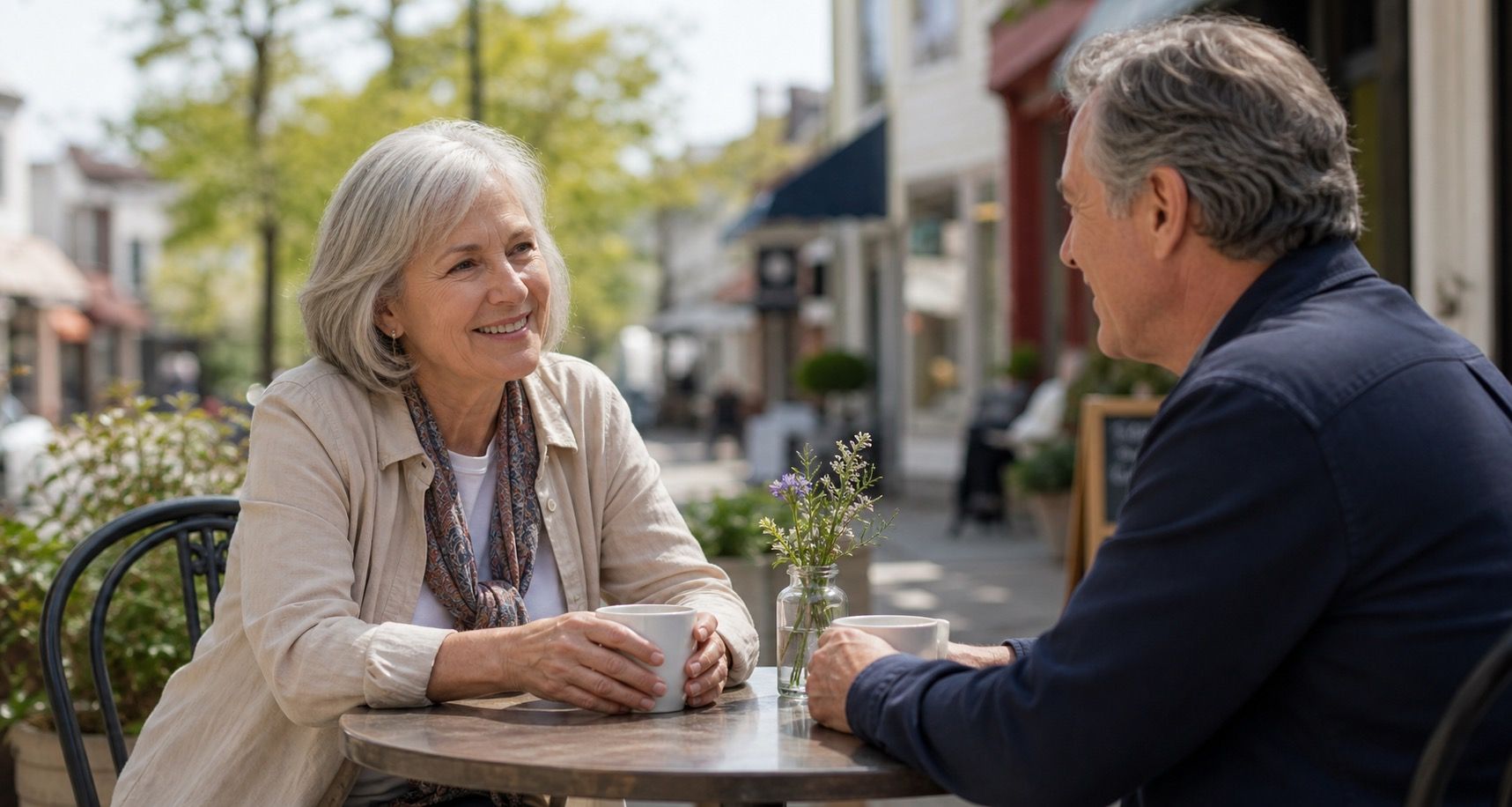
By the time they met a few days later at a cafe with a patio overlooking a municipal garden — the kind of place with mismatched chairs and a chalkboard menu that had not changed in years — Marianne had reduced the whole thing to a scale she could manage. It was coffee. It was conversation. It was two people seeing whether an ease that existed in one setting remained present in another.
The hour passed in a way that confirmed her instinct about pace. Thomas was interested, but not insistent. He asked about her work, her grown son in Oregon, the reading group she sometimes helped organize. He did not push for the next disclosure simply because one had been made. The conversation had shape without acceleration.
With Thomas, she left feeling more settled than when she arrived. That feeling helped her understand something she had not been able to say clearly before. Moving slowly was not a way of avoiding connection. It was the condition under which connection felt believable to her. If you need words for that preference in your own life, How to Tell Someone You Want to Take Things Slowly can help.
There was also relief in not having to turn that preference into a philosophy. She simply recognized her own threshold more clearly. She liked warmth. She did not like being hurried into significance.
What the Right Pace Revealed
Once Marianne stopped treating slowness as something she needed to apologize for, she began to see how much it clarified.
A faster beginning might have rewarded the wrong qualities: charm, responsiveness, the ability to generate momentum. A slower pace brought different details forward. Did Thomas do what he said he would do. Did his tone remain steady from week to week.
The answers accumulated quietly. He remembered small things without performing attentiveness. He suggested another coffee the following week, then accepted without fuss when Marianne said the week after would suit her better. When she mentioned that some evenings she preferred not to be on the phone, he simply adjusted.
It also became easier for Marianne to notice herself. She was not bracing before seeing him. She was not rereading messages and feeling depleted. When they did speak, she looked forward to it. That difference can be useful if you are trying to tell the difference between calm connection and draining effort in your own life; What to Do When Dating Starts to Feel Draining After 50 explores that more directly.
That distinction can be reassuring for readers who worry that slow connection may be too thin to trust. Not every meaningful beginning announces itself through urgency. Sometimes the stronger sign is that nothing feels inflated. If the quiet itself has started to worry you — if you are wondering whether calm means connection or just comfort — understanding what a calm relationship means after 50 can help you tell the difference. Marianne eventually realized that pace was not separate from compatibility. It was part of compatibility.
What Companionship Looked Like in Real Life
By the time Marianne allowed herself to think of Thomas as more than a pleasant part of the library sale, the connection still looked modest from the outside.
They had coffee. They went once to a chamber music performance at a local church and once to a late lunch after wandering through a garden show that both of them found mildly interesting and slightly overpriced. He called sometimes. She called less often, but by then the silence between conversations did not feel fragile.
Nothing about the relationship, if it could even be called that yet, resembled a dramatic reordering of her life. That turned out to be one of its strengths. Marianne was still reading in bed, still meeting her friend on Thursdays, still pruning the patio plants and eating toast over the sink if she felt like it. The difference was that companionship had begun to enter the week in believable ways. A familiar voice on a Tuesday afternoon. Another chair at lunch now and then.
For a long time, Marianne had assumed that if she let someone in again, the choice would have to feel larger than this to count. Instead, she discovered that what made the connection feel meaningful was precisely its scale. It asked for attention, but not surrender. It created warmth without requiring immediacy. That was enough to be real.
Where This Leaves You
For some people, companionship begins with relief.
Relief that interest does not have to become intensity right away. Relief that taking your time is not the same as holding back forever. Relief that another person can enter your life without immediately asking it to change shape around them.
Marianne’s story is not unusual. Research consistently shows that what older adults most often report wanting is not passion or excitement but companionship — someone to share meals with, to talk to at the end of the day, to sit beside at a concert. The University of Michigan poll found that the specific form of loneliness most commonly reported by older adults is “lack of companionship” — not lack of romance, not lack of social activity, but the absence of a steady, familiar presence.
If that is the kind of connection you want, it may help to trust its scale. A slower pace does not make a feeling less sincere. It may be what allows sincerity to remain visible. The more useful question is whether being with someone leaves you calmer, more yourself, and quietly glad they were there.
For many people, that is where something honest begins — not with a spark, but with the absence of strain.
If you want the broader framework for naming that kind of connection, What Companionship Can Look Like After 50 places it inside the larger later-life picture. And if you are still deciding whether that kind of connection is more likely to begin through everyday life or through apps, Dating Apps vs Meeting People Offline After 50 can help you think about the path, not just the feeling.