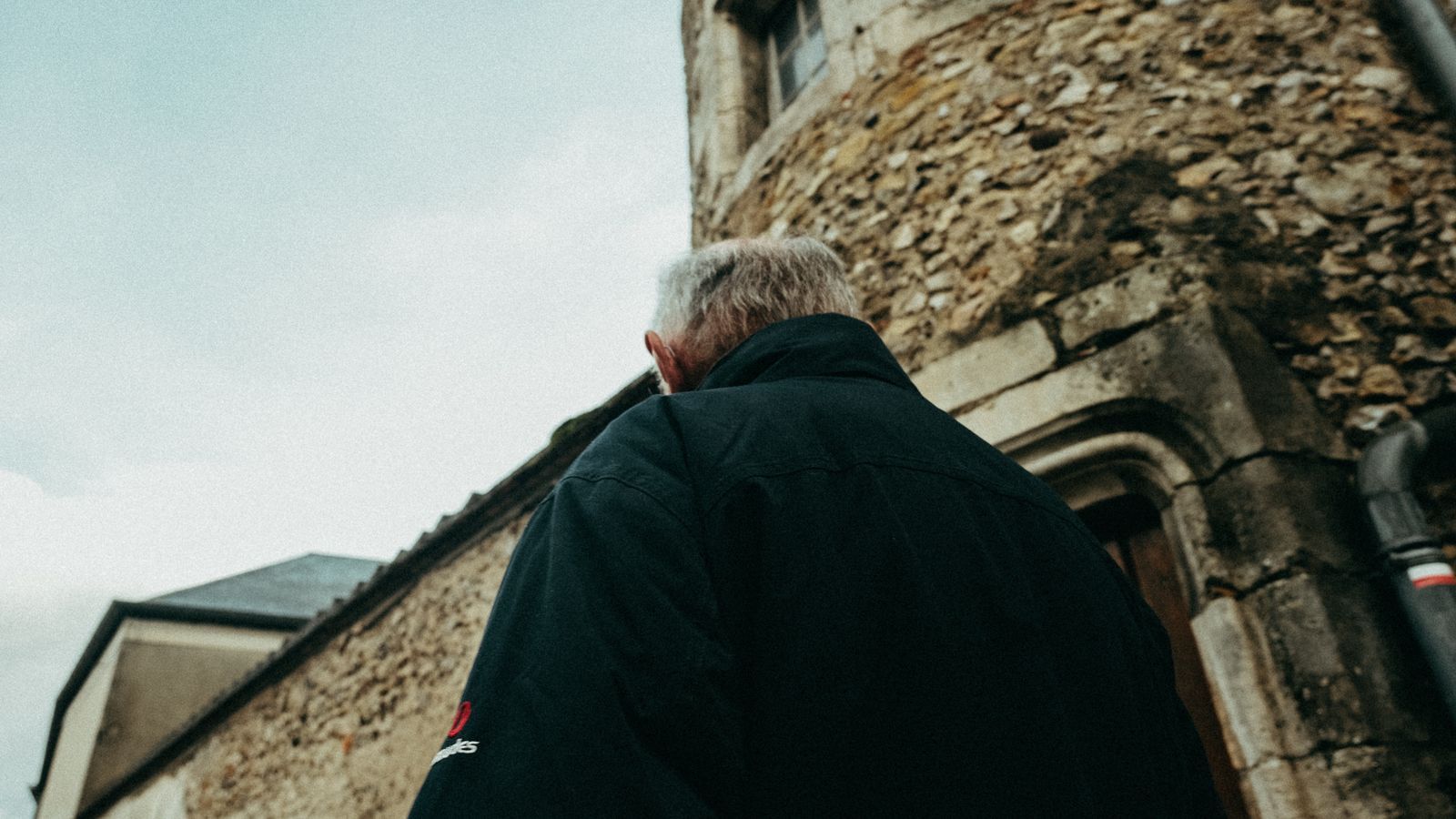
This story is based on a real conversation. Details have been changed to protect privacy — names, locations, and identifying circumstances have been altered — but the emotional arc and the specific experiences described reflect what was shared with us. We publish stories like this because the research on widowhood and dating tends to focus on statistics and timelines, while the actual felt experience — the loyalty questions, the self-consciousness, the strange sharpening of loneliness after a decent date — rarely gets described in practical terms.
The man at the center of this story, whom we will call David, did not decide to start dating again. That is not quite how it happened. What happened was slower and less deliberate than a decision, and by the time he recognized it for what it was, the feeling had already been present for a while.
David was 59 and had been widowed for a little over three years. His wife, whom he had been married to for twenty-eight years, had died after a short illness that moved faster than anyone expected. The grief that followed arrived in full and stayed longer than he imagined, and then, gradually, it became quieter without ever fully leaving.
He does not describe himself as someone who has moved on. He would not use that phrase. What he says is that life continued and eventually he continued with it.
When Grief Becomes Ordinary Life
There is a stage of widowhood that rarely gets described in dating advice or even in grief literature. It comes after the acute period, after the condolence cards and the difficult firsts, after friends stop checking in with the same frequency. It is the stage where grief stops being the main event and becomes part of the ordinary texture of a week.
Research from the University of Michigan found that most older adults are resilient and return to earlier levels of psychological health within about 18 months of spousal loss. But “returning to earlier levels” does not mean the loss disappears — it means life reorganizes around it. A 2024 systematic review in the Journal of the American Geriatrics Society confirmed that loneliness after spousal loss can persist well beyond that initial adjustment period, particularly emotional loneliness — the specific absence of a close confidant.
For David, that transition did not happen cleanly. There was no morning when he thought, I am no longer grieving. It was more that the days began to fill with other things. Work. The garden. His daughter calling on Sundays. A neighbour who needed help with a fence. The rhythm of a life that had contracted after his wife’s death slowly expanded again — not because he willed it to, but because time kept moving and he kept answering it.
He still thought about her often. But the quality of the thinking shifted. It became less like being pulled under and more like noticing weather. He could make dinner, read the paper, fall asleep in front of the television, and none of that felt like betrayal.
What surprised him was how functional the loneliness could be. He was not miserable. He had friends, a routine, enough to do. But there was a particular quality to evenings — and to weekends when nothing was planned — that he noticed more as time went on. Not desperation. More like a low-grade awareness that the house was very quiet and that quiet had a weight to it he had not chosen.
He did not romanticize his wife’s absence or turn their marriage into something flawless. They had been ordinary together: steady, imperfect, warm enough, occasionally irritating, mostly good. He missed the ordinary version of her. He missed someone knowing what he meant without explanation. He missed the sound of another person in the kitchen at seven in the morning.
That kind of missing does not always look like grief from the outside. It can look like a man who is doing fine.
The First Return of Possibility
The shift, when it came, was not dramatic. David did not wake up wanting to date. He did not have a revelation or a conversation that changed his mind.
A woman at his local walking group made a comment one morning — something about the council’s decision to repave the towpath, delivered with a dryness that caught him off guard — and he laughed in a way he had not expected. It was not flirtation. It was not even particularly memorable as a remark. But he noticed, afterward, that he had enjoyed the exchange more than the walk itself. He noticed that he thought about it again that evening while making tea.
That noticing was the beginning, though he would not have called it that at the time. More like a door opening a crack in a room he had assumed was permanently shut. Not a door he walked through. Just the awareness that it was not locked.
Over the following weeks, he found himself paying slightly more attention to the social parts of his life. Not seeking anything out. But registering, with quiet surprise, that he was not entirely indifferent to the idea of company that went beyond friendship. The feeling was tentative and slightly embarrassing. He did not mention it to anyone.
What made it complicated was that the feeling did not arrive with permission attached. His wife had not asked him to remain alone. His daughter had even said she would be glad if he met someone. For readers wrestling with how to name that transition out loud, the guide on telling friends and family you are dating again after 50 addresses that conversation directly. And yet the feeling carried a faint charge of disloyalty that he could not entirely reason away.
It was not guilt, exactly. More like self-consciousness. As if wanting something for himself — something that had nothing to do with his wife and could not include her — required a kind of separation he had not yet fully made. The bond was still intact. She was still the person he had been married to. And here he was, noticing a woman’s laugh at a walking group and thinking about it over tea.
This is more common than people realize. Research on repartnering after widowhood shows that men tend to consider dating sooner than women — by 25 months after a spouse’s death, about 61% of widowers are either in a new relationship or actively dating, compared to 19% of widows (Schneider et al., 1996). But “sooner” does not mean “easily.” The loyalty question David describes — wanting connection while still feeling married in some interior way — appears consistently in qualitative research on widowed adults who begin dating.
He did not act on it. Not then. But he stopped pretending the question did not exist. Our guide to how to start dating again after 50 describes readiness as something that often arrives unevenly, without a clean starting signal. David would probably agree, though he might add that for him the unevenness had a specific texture: it felt like wanting two things at once that should not have been in conflict but were. If that tension between willingness and hesitation feels familiar, How to Know If You’re Ready to Date Again After 50 explores what readiness actually tends to feel like at this stage.
Loyalty, Permission, and Being Seen
The hardest part was not the idea of meeting someone. It was the idea of being seen to be meeting someone.
David’s daughter, Claire, had said the right things more than once. “I’d be happy for you, Dad.” “Mum wouldn’t have wanted you to be alone.” He believed her. He also knew that believing her and feeling free to act were not the same thing. There was a difference between abstract approval and the concrete reality of her father sitting across from a stranger in a restaurant. He imagined the brief pause before she responded if he mentioned it casually. Not dramatic. But it sat in the room with him.
Research bears this out. A study published in The Journals of Gerontology found that widowers’ dating can affect parent-child closeness — but the direction depends on the existing relationship. Where parent-child bonds were already strong, dating actually enhanced closeness. Where they were strained, it created further distance. The study also found that parent-daughter relationships were more sensitive to a father’s dating than parent-son relationships. David did not know this research, but he seemed to sense the dynamic intuitively.
His friends were less complicated. A few had made gentle suggestions. One had said, with the bluntness of long friendship, that David was too young to spend every evening alone with the news. He appreciated the concern. He also noticed it came more easily from people who had not lost a spouse themselves.
What nobody quite named was the loyalty question. Not loyalty as obligation — he did not believe his wife was watching or keeping score. It was loyalty as identity. For twenty-eight years, he had been someone’s husband. That role had not ended when she died. It had simply lost its living counterpart. He still felt married in some interior way that did not require her presence to persist. Dating asked him to make room beside that feeling, and he was not always sure he knew how.
There was also the idea of being interpreted. If he dated, people would know. The neighbours. His wife’s sister. He would become, in their eyes, a man who had moved on. He disliked that phrase because it implied a direction — forward, away — that did not match what he felt. He was not moving away from anything. He was standing in the same life and wondering whether there was room in it for something he had not planned.
That wondering took months to settle into anything resembling action.
A First Conversation That Was Not a Beginning
David did not go on a date in any formal sense for a long time. What he did, eventually, was join an online platform after reading about it in a weekend newspaper column that made the whole thing sound ordinary enough to attempt. For anyone still at the stage of deciding whether apps are even the right starting point, the beginner’s guide to online dating after 50 covers that entry step more practically.
The profile was the worst part. He sat with his laptop open at the kitchen table for the better part of an evening, a cup of tea going cold beside him, writing and deleting sentences that sounded either too stiff or too eager. He did not know how to describe himself outside the context of a life that had included someone else. He wrote that he enjoyed walking, cooking, and reading, then stared at the words and thought they could describe almost anyone. He added something about the garden, then took it out because it sounded like he was advertising a retirement.
He decided to mention being widowed because the alternative felt dishonest. He wrote: “Widowed three years ago after a long marriage. Life is steady now. Open to seeing what’s out there.” He was not sure about “what’s out there” — it sounded vaguely like a travel brochure — but he left it because rewriting it again felt worse than publishing something imperfect.
After a week of brief, polite exchanges that mostly fizzled after three or four messages, he agreed to meet one woman for coffee. Her name was Susan. She was 57, divorced, and seemed straightforward in a way he appreciated. They met at a cafe near the river on a Saturday morning. He arrived fifteen minutes early and sat with the newspaper, pretending to read it.
The conversation was easy enough. They talked about work, the town, adult children, the mild absurdity of online dating at their age. She was warm and direct. He liked her. He did not feel a spark, but he was not sure he had expected one — or even what a spark would feel like at 59, after everything.
What he noticed most was the strangeness of being across from someone who did not know his wife. Susan had no context for the life he had lived before this coffee. That gap felt larger than he had anticipated. Not painful, exactly. But present. Like sitting in a room where the furniture had been rearranged and nobody had mentioned it.
He mentioned being widowed once, early on, and she responded with a brief, kind acknowledgment that did not linger. He was grateful for that. Saying the word aloud to a stranger felt different from typing it into a profile. It made the fact more real and more separate from him at the same time. For readers still working out how much to say in that moment — and how to keep it from becoming the whole conversation — the guide to sharing divorce or widowhood without making it the whole date addresses that practical question directly.
Afterward, he sat in the car for a minute before driving home. The house was quiet in the usual way. He made lunch — cheese on toast, the kind of meal his wife would have called “not really lunch” — and thought about the morning without reaching any conclusion. It had been fine. He was not sure whether he would see Susan again. What mattered was that he had gone. That his wife’s photograph was still on the shelf in the hallway and he could look at it without feeling like he had done something wrong.
That was enough for one Saturday.
What Felt Unexpectedly Hard
David had expected awkwardness. What he had not expected was the specific quality of comparison that followed him into every interaction — not as jealousy or idealization, but as a kind of background measurement he could not switch off.
With his wife, conversation had not required setup. There had been decades of shared shorthand — knowing which stories were funny, which subjects to leave alone, which silences were comfortable and which meant something was wrong. With someone new, everything required explanation. Not in a burdensome way, necessarily. But in a way that reminded him how much context a long marriage accumulates without anyone noticing.
His life was full of references that assumed a listener who already knew the background. His daughter’s childhood. The house they had renovated in 2009, the year the boiler failed twice. The holiday in Scotland where everything went wrong and became funny afterward. Telling those stories to someone who had not been there required a kind of editing that felt both necessary and faintly dishonest — as if he were presenting a highlight reel of a life that had actually been lived in full.
The loneliness after a decent interaction surprised him too. He had imagined that meeting someone pleasant would reduce the quiet of the house. Instead, the first few times, it sharpened it. Coming home after coffee with Susan, or later with another woman named Helen, he noticed the silence more acutely than on an ordinary evening. Not because the meetings had gone badly. Because they had gone well enough to remind him what company felt like — and then ended. The front door closing behind him sounded different on those evenings.
If you are navigating something similar and find that communicating your pace feels uncertain, our piece on how to tell someone you want to take things slowly may be useful. David arrived at a version of the same instinct on his own: that being honest about needing time was simpler than performing readiness he did not feel. And if you are still deciding whether companionship is what you want more than romance, What Companionship Can Look Like After 50 offers the broader framework, while Finding Companionship Later in Life Without Rushing shows that preference in lived detail.
What “Starting Again” Came to Mean
David did not fall in love. That is not where this story ends. He did not find a partner or a relationship he would describe with confidence as serious. What he found, over several months of cautious, intermittent contact with a few different people, was something less conclusive and possibly more honest.
He could sit across from someone and enjoy the conversation without feeling like a traitor. Mentioning his wife did not have to be a confession or a warning — it could just be a fact, offered plainly, received without drama. Some evenings were better shared and some were better alone, and both could be true in the same week without contradiction.
He also found that “starting again” was the wrong phrase. He was not starting again. He was continuing. The life he had built with his wife was still his life. Dating did not erase any of that. It simply added a small, separate room that had not existed before — a room he could enter or leave without the rest of the house changing shape.
Some weeks he entered it. Some weeks he did not. He exchanged messages with Helen for a while and then the conversation thinned naturally. He met another woman briefly and knew within twenty minutes that the fit was wrong, and felt no guilt about that either. He continued going to the walking group. He continued making dinner for one most nights. He bought a new cookbook — something he would not have done a year earlier, when cooking for one still felt like evidence of something missing.
If there was a change, it was not in his circumstances. It was in the weight of the question. Dating no longer felt like a betrayal or a statement. It felt like something he could do occasionally, without urgency, without narrative, without needing it to mean more than it did.
He would not say he was happy about it, exactly. He would say it was manageable. He would say the question had become smaller, and that smaller was enough.
If David’s experience resonates with you, you are not alone in it. Research consistently shows that widowed adults who begin dating face a specific set of emotional challenges — the loyalty question, the identity shift, the complicated reactions of adult children — that divorced adults and never-married adults do not encounter in the same way. For a practical guide to navigating those challenges, including a readiness self-assessment and advice on talking to family, see How to Date After Losing a Spouse in Your 60s. There is no correct timeline. The median interval to repartnering for widowed men is about 1.7 years; for women, about 3.5 years. But many people never repartner, and that is equally valid. The only question that matters is whether the life you are living feels like enough — and whether “enough” might include room for something you had not planned.